
Spices & Medicinal Herbs
TURMERIC
(Curcuma longa)
Turmeric is a widely used spice in daily life for cooking, food coloring, and as a valuable medicinal herb for various ailments.
Spices & Medicinal Herbs
Care Notes
TURMERIC
Curcuma longa
1. Characteristics
Perennial herb with strong rhizomes. Leaves are large like canna leaves, soft and fragrant.
2. Uses
Cooking spice (curry, coloring), food dye, and treatment for stomach ulcers.
3. Technique
Plant in Spring (Feb-Mar). Requires loose soil, plenty of Potassium.
I. USES
Turmeric is a spice widely used in daily life. It is used to cook dishes like curry, snail stew, taro soup, or for marinating food.
Turmeric is also used as a very safe natural food coloring.
Turmeric is a precious medicinal herb used to treat certain diseases: stomach ulcers, duodenal ulcers, etc.
II. BIOLOGICAL CHARACTERISTICS
- Origin: Turmeric is a perennial herb, originating from tropical South Asia, in warm temperature regions.
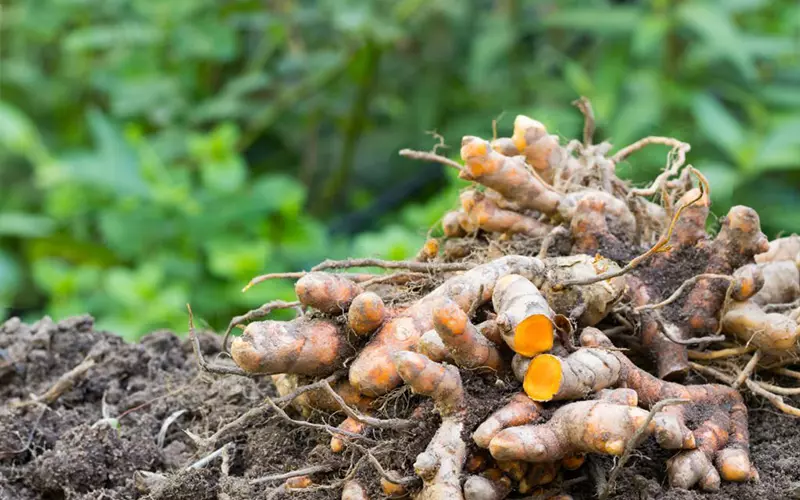
- Stem & Rhizome: The rhizomes (tubers) develop strongly and swell to become the usable part. The pseudostem is formed by leaf sheaths. It can grow up to a meter high depending on the variety and conditions.
- Leaves: Large and broad like Canna leaves, but soft and fragrant.
- Climate: Prefers scattered light, can grow at forest edges or under the canopy of unclosed woody trees. It is drought-tolerant.
- Soil: Grows well in soil with a thick cultivation layer, loose, porous, and rich in organic matter.
- Nutrition: Very sensitive to potassium deficiency in the soil. Therefore, turmeric soil must be adequately fertilized with potassium.
III. CULTIVATION TECHNIQUES
1. Season
- North: Areas with warm spring plant in February, March, or latest by mid-April.
- South: Can plant at the beginning of the dry season, from November to December.
2. Soil & Fertilizers
Soil Preparation: Plow thoroughly, clear weeds. Raised beds should be 1.0 - 1.2m wide, 0.25 - 0.30m high.
- Organic Fertilizer: 1.5 - 2.0 tons
- NPK: 40 - 50kg
- Super Phosphate: 20 - 30kg
- Potassium Chloride: 15 - 20kg
* Basal dressing: All organic fertilizer, phosphate, and 1/3 potassium. Mix well with soil in holes/furrows.
3. Spacing & Planting
- Spacing: 40 - 50cm (rows) x 25 - 30cm (plants).
- Planting: Choose healthy rhizomes without pests, cut into sections with 2-3 buds. Place the seed tuber, press lightly to contact soil. Cover with fine soil 5-6cm thick.
4. Care
- Watering: Keep moist daily 1-2 times. Provide ample during strong growth periods. Stop watering 3-4 weeks before harvest.
- Hilling & Weeding: When plants emerge, hoe lightly to break surface crust and hill up gently while weeding. Hill up high when plants have 4-5 leaves.
- Top Dressing: Fertilize at stages: 1-2 leaves, 2-3 leaves, 4-5 leaves, and during tuber development. Dissolve fertilizer in (1-2%) or apply dry 7-10cm from base then water.
- Note: Do not overuse inorganic nitrogen (excessive foliage harms tuber growth). Provide sufficient Potassium during tuber formation.
IV. HARVEST
After planting for about 10 - 12 months , when the turmeric is old, basal leaves turn yellow and wither, and tubers are yellow, it can be harvested.
Method: Use a hoe to dig soil on both sides of the bed, then pull up the whole plant, use a knife to cut off the stems and leaves, then sort.
Storage: After drying the skin, store in a dry, cool place.
Growing Conditions
Fertilizer per 1,000m²: Organic Fertilizer: 1.5 - 2.0 tons NPK: 40 - 50kg Super Phosphate: 20 - 30kg Potassium Chloride: 15 - 20kg * Basal dressing: All organic fertilizer, phosphate, and 1/3 potassium. Mix well with soil in holes/furrows. 3. Spacing & Planting Spacing: 40 - 50cm (rows) x 25 - 30cm (plants). Planting: Choose healthy rhizomes without pests, cut into sections with 2-3 buds. Place the seed tuber, press lightly to contact soil. Cover with fine soil 5-6cm thick. 4. Care Watering: Keep moist daily 1-2 times. Provide ample during strong growth periods. Stop watering 3-4 weeks before harvest. Hilling & Weeding: When plants emerge, hoe lightly to break surface crust and hill up gently while weeding. Hill up high when plants have 4-5 leaves. Top Dressing: Fertilize at stages: 1-2 leaves, 2-3 leaves, 4-5 leaves, and during tuber development. Dissolve fertilizer in (1-2%) or apply dry 7-10cm from base then water. Note: Do not overuse inorganic nitrogen (excessive foliage harms tuber growth). Provide sufficient Potassium during tuber formation. IV. HARVEST After planting for about 10 - 12 months , when the turmeric is old, basal leaves turn yellow and wither, and tubers are yellow, it can be harvested. Method: Use a hoe to dig soil on both sides of the bed, then pull up the whole plant, use a knife to cut off the stems and leaves, then sort. Storage: After drying the skin, store in a dry, cool place. Fertilizer (per 1,000m²) 1.5-2 Tons Organic 40-50 kg NPK 20-30 kg Super phosphate 15-20 kg Potassium Growth Process Planting
Spring (Feb-Apr) or early Dry Season.
Care & Top Dressing
Stages: 1-2, 2-3, 4-5 leaves. Hill up high.
Tuber Formation
Requires sufficient Potassium and water.
Harvest
After 10-12 months. Yellow leaves, mature tubers.