Japanese maple (Acer palmatum) is one of the most sought-after deciduous bonsai in the world, and also the one that disappoints beginners most often. Proper japanese maple bonsai care preventing leaf scorch and pruning is what decides whether your tree carries a blazing autumn canopy or nothing but crisp brown leaf margins from midsummer onward. This guide digs into the real cause of leaf scorch, how to arrange light and water, and the pruning calendar that builds fine ramification.
Unlike juniper or ficus, Japanese maple has thin, broad leaves and a water-transport system that is easily disrupted. Grown in a shallow bonsai pot, the tree becomes even more vulnerable, because the soil holds far too little moisture for the canopy's transpiration demand.
Why do Japanese maple bonsai leaves scorch at the edges?
Leaf scorch is not a fungal or bacterial disease. It is physiological damage that appears when water lost through the leaves outpaces what the roots can absorb and deliver upward. The furthest points along that transport route — the leaf margins and lobe tips — run short of water first, the tissue dies, and it turns brown and brittle.
Four factors push the tree into this imbalance. First, harsh afternoon sun striking the canopy once air temperature has already climbed. Second, constant dry wind, which raises transpiration and is routinely overlooked because it is invisible. Third, letting the pot dry out completely even once on a hot day. Fourth — and least suspected — irrigation water high in salts or alkalinity, which accumulates in the soil and blocks root water uptake.
One thing matters above all: once a leaf margin has burned brown, that tissue never recovers. A scorched leaf keeps its brown edge until it drops in autumn. So the entire strategy has to be prevention, not treatment. If you see a few leaves starting to burn at the edges, treat it as a warning to move the tree immediately, before the whole canopy is affected.
It is also worth separating leaf scorch from whole-tree heat shock. Scorch develops gradually at the margins; heat shock wilts entire leaves and drops them in bulk within hours. See signs of summer heat shock in bonsai to tell the two apart and respond in time.
Light placement: morning sun, afternoon shade
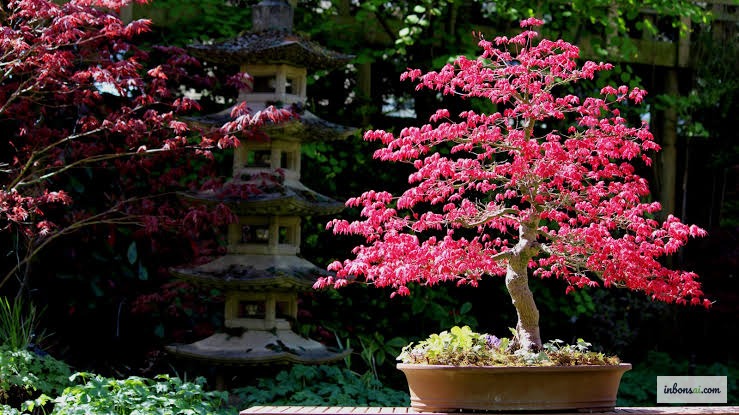
The golden rule for Japanese maple bonsai is morning sun and afternoon shade. Sunlight from roughly 6 to 11 a.m. has moderate intensity while air temperature is still cool, driving strong photosynthesis without stress. From noon onward, and especially between 1 and 4 p.m., sun plus high heat is a reliable recipe for scorch.
In practice, place the tree on the east side of a wall, fence, or large tree. That position collects the full morning sun and is shaded automatically once the sun passes overhead. If your balcony or yard faces only west or south, stretch 30–50% shade cloth above the tree. Thirty percent is enough in mild climates; harsh-sun regions should use fifty.
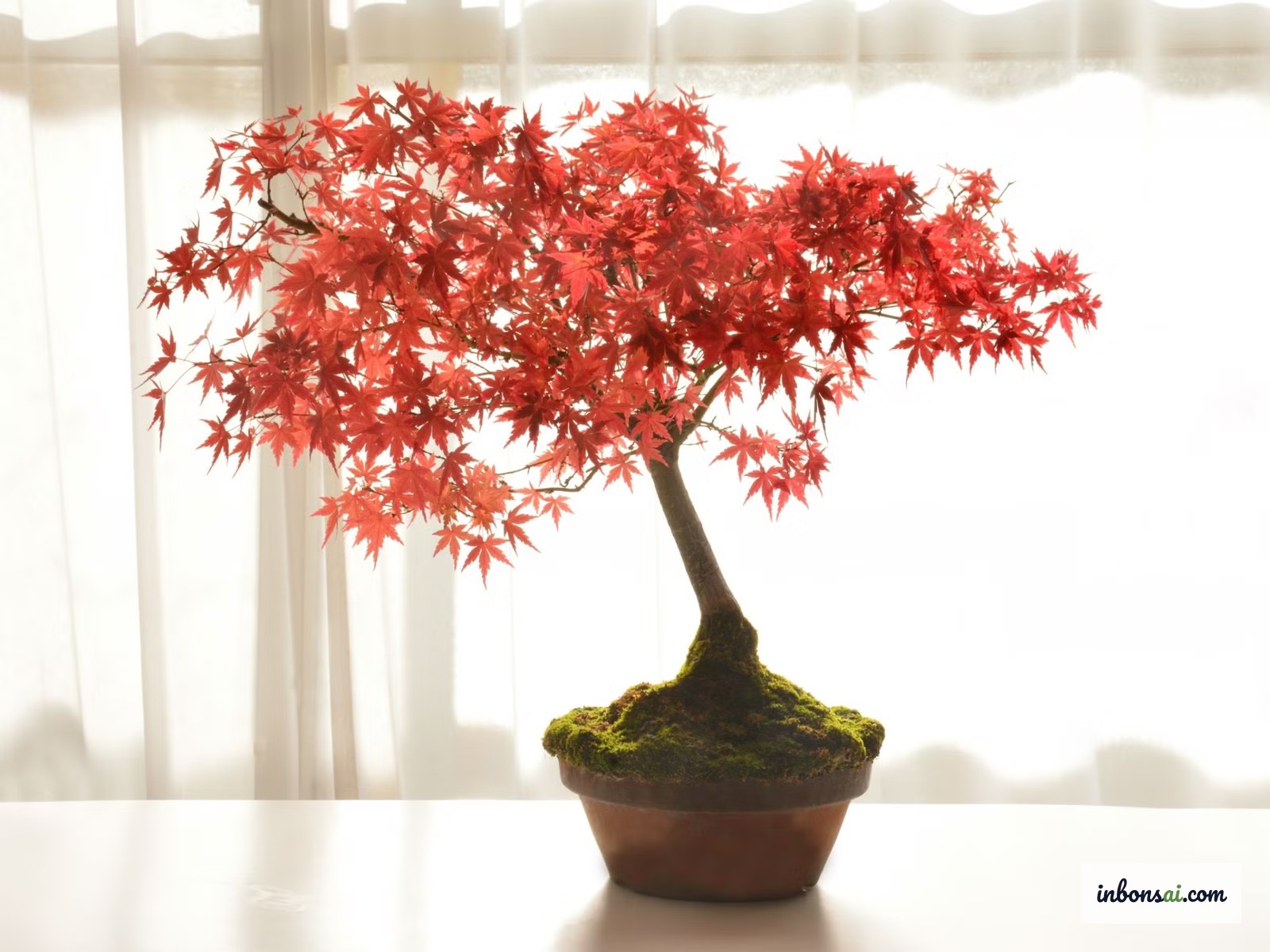
Red-leaved cultivars and finely dissected forms are markedly more sensitive than plain green ones. Green-leaved types such as the straight species tolerate perhaps one to two more hours of sun per day. Variegated cultivars with white or pink leaf margins, like 'Butterfly', are the most scorch-prone group and essentially require afternoon shade.
An easily missed detail is radiant heat bouncing off the floor. Concrete, tile, and metal surfaces absorb heat all day and then throw it back at the pot, driving soil temperature up even when the canopy is shaded. Raising the pot onto a 30–50 cm wooden stand, or setting it on a bed of damp gravel, cuts that heat load substantially.
Watering and water quality for Japanese maple
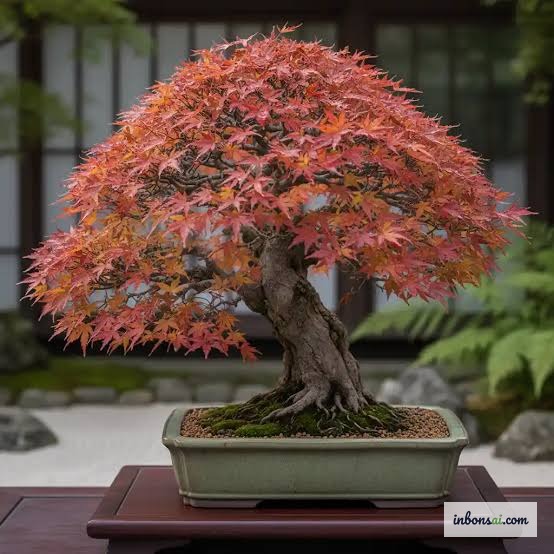
Japanese maple needs steady soil moisture — neither waterlogged nor bone dry. Extreme wet–dry swings are the true enemy of maple foliage. On a hot summer day, a mature tree in a shallow pot may need water twice: early morning and late afternoon once the sun has softened.
The accurate way to check is to push a finger or a wooden chopstick about 2 cm into the soil. If it is dry at that depth, water. Do not water on a fixed schedule, because demand shifts with temperature, humidity, and canopy size. When you water, water until it runs freely from the drainage holes, then repeat a minute later so the whole root ball is evenly soaked.
Water quality is the factor most growers ignore. Japanese maple prefers slightly acidic soil around pH 5.5–6.5 and is very sensitive to dissolved salts. Hard or brackish tap water accumulates salt in the soil over many waterings, producing scorched margins that look exactly like drought damage. Collect rainwater if you can. If you use tap water, once a month flush heavily — about three times the normal volume — to leach out accumulated salts.
Never water with water that has been sitting in a hose in the sun. Hose water can reach 50–60°C, hot enough to cook fine roots. Run off a few litres before it touches the tree.
Structural pruning: shaping the branch framework in dormancy
Pruning a Japanese maple splits into two entirely different jobs with different timing. Structural pruning targets larger branches to set the overall framework, and should only be done while the tree is dormant — after leaf drop and before the buds begin to swell.
The reason for waiting is very practical: Japanese maple bleeds sap heavily. Cutting a large branch in spring while sap is rising causes days of continuous bleeding, weakening the tree and raising the risk of dieback. In midwinter the sap flow has all but stopped and the wound heals cleanly.
When you do structural work, read the leafless tree as a blueprint. Remove branches growing vertically off the top of a horizontal branch, branches hanging straight down, branches crossing the trunk, and pairs emerging from the same point — those create ugly swelling at the branch base. Favour branches that radiate outward and taper as they climb.
Cut large branches flush and slightly concave so callus can close over them. Seal any wound over 1 cm across. If you plan to reposition branches with wire after structural pruning, see the 45-degree wiring technique that avoids bark scarring — Japanese maple bark is thin and scars quickly.
Pinching for fine ramification during the growing season
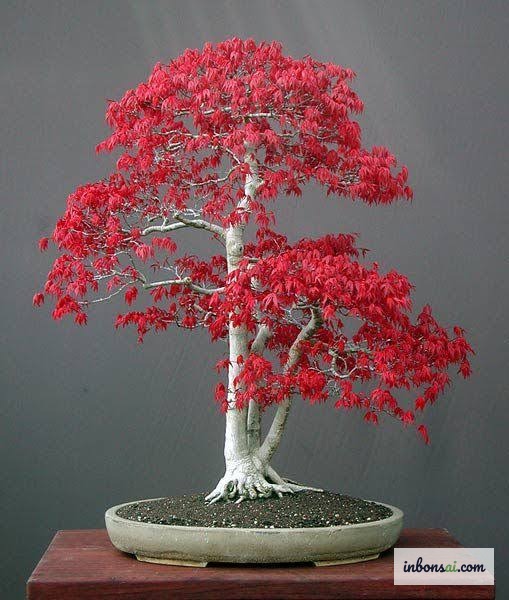
If structural pruning builds the skeleton, growing-season pinching creates the refinement that makes a maple beautiful. The aim is to force repeated division, turning one coarse branch into a lace-like network of fine twigs — the most prized characteristic of Japanese maple bonsai.
The basic technique is called leaf-pair pinching. Japanese maple produces leaves in opposite pairs, and a dormant bud sits in the axil of each pair. Once a new shoot has extended three or four pairs of leaves, use fine scissors to cut off the tip, leaving only the first one or two pairs. The tree then pushes two new shoots from the axils of the remaining pair, turning one tip into two. Repeat this across several flushes and twig density multiplies.
You control the direction of the new twigs by choosing which pair to leave. Whatever axis the final retained pair sits on is the axis the two new shoots will follow. Leave a horizontal pair for spreading twigs; leave a vertical pair for rising ones.
Do not pinch the whole tree uniformly. Weak areas — lower branches and interior twigs — need to run free longer to regain vigour, while the apex and outer branches, naturally stronger, need early and firm pinching. This balancing principle keeps the tree from becoming top-heavy over a weak base.
Partial defoliation: when to do it and when not to
Defoliation means cutting leaves off in early summer to force a second, smaller flush and let light into the interior twigs. It is a powerful technique, and the one most frequently abused on Japanese maple.
The safe rule is partial only — never total. Remove roughly 30–50% of the leaves, concentrating on the large ones at the apex and the outer surface of the canopy, where they shade the interior. Leave the foliage on weak branches and deep inside the canopy untouched. Cut through the petiole with scissors and leave about 5 mm of stalk; do not tear leaves off, as that damages the dormant bud in the axil.
The only suitable window is early to midsummer, once the spring flush has fully hardened and enough of the season remains for the new flush to mature before autumn. Defoliating late in summer produces soft growth that cannot harden before cold weather, inviting dieback.
Only defoliate a healthy tree. Trees repotted the same year, trees that have just had heavy structural pruning, trees showing decline, and trees under pest or disease pressure must all be left alone. For these, give the tree a season to rebuild strength and reconsider next year.
Soil, repotting, and seasonal care
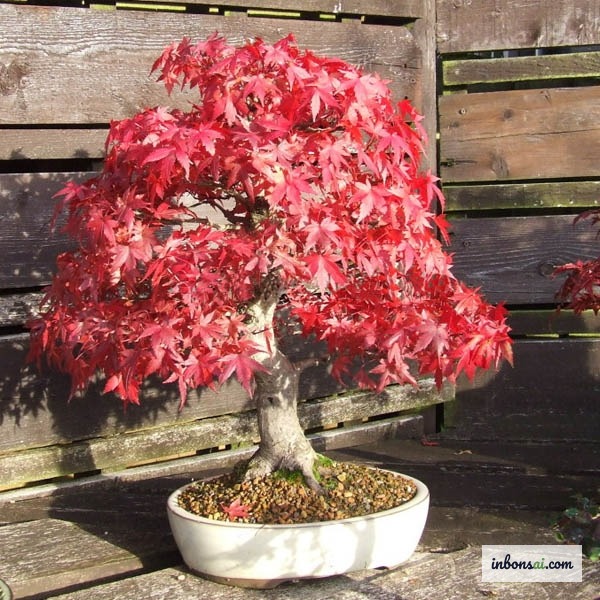
The soil mix largely determines scorch resistance, because it governs both moisture retention and aeration. A common recipe for Japanese maple is akadama, pumice, and lava in roughly a 2:1:1 ratio. Akadama holds moisture and is slightly acidic, matching the maple's pH preference. In hot climates raise the akadama proportion to hold water longer; in wet climates raise the pumice for drainage.
Repot in late winter or early spring, once buds begin to swell but before they open. Young trees every two years, mature trees every three to four. At repotting, trim roughly one third of the root mass, cutting thick anchor roots preferentially and keeping the fine feeder roots. A freshly repotted tree needs full shade for two to three weeks and no fertiliser for the first month.
Feed a balanced NPK through the growing season, but stop nitrogen from late summer. Late nitrogen pushes soft growth that cannot harden before cold and washes out autumn colour. From late summer, switch to higher phosphorus and potassium so the tree stores reserves in its branches and roots.
Autumn is when a Japanese maple repays every bit of care with blazing red and orange foliage. The best colour needs a clear day-night temperature swing and good morning sun. After leaf drop the tree enters dormancy and its roots need protection from frost — read autumn bonsai care in preparation for dormancy for the full sequence.
Seasonal care calendar for Japanese maple bonsai
Pulling the whole year together makes it harder to miss a critical window.
Late winter is the season for structural pruning and repotting. The leafless tree shows its framework clearly, and with sap flow stopped, wounds heal fast. This is also when you wire the larger branches into position.
Spring is about protecting the new flush. Emerging maple leaves are extremely delicate and scorch from both sun and wind. Keep the tree sheltered until the leaves harden, resume regular watering, and begin dilute feeding once the leaves have fully opened.
Summer is the most intense scorch-prevention phase: afternoon shade, watering twice daily, checking soil moisture at midday, and carrying out pinching and partial defoliation in early summer. It is also the time to watch closely for spider mites, which thrive in hot dry conditions and bleach maple foliage.
Autumn means tapering water down as growth slows, cutting nitrogen, and enjoying the colour. After leaf drop, clear fallen leaves off the soil surface to prevent fungal problems overwintering, then move the tree somewhere sheltered from cold wind and frost at the roots.
Tags
#japanese-maple-bonsai#leaf-scorch#bonsai-pruning#acer-palmatum#deciduous-bonsai-careGet bonsai guidance every week.
Fresh care guides, styling notes, and bonsai inspiration delivered to your inbox.