The Elegant Beauty of the Ochna Tree
Since ancient times, it is no coincidence that people have vied to compose poems praising the beauty of the Ochna tree. It is even less of a coincidence that many ancient Chinese painters over the centuries have shown their talent in painting apricot blossoms (often associated with Ochna in this context), leaving names that have been passed down to this day, making posterity bow in admiration!
So, what is the beauty of the Ochna tree that is strong enough to attract the special attention of people from the past to the present to such an extent?
Regarding this, we venture to think that: it is due to the elegant beauty hidden within the Ochna tree, which is the main reason creating the magical attraction that draws attention to the point of passion and high admiration from people...
The Appearance of the Ochna Tree:
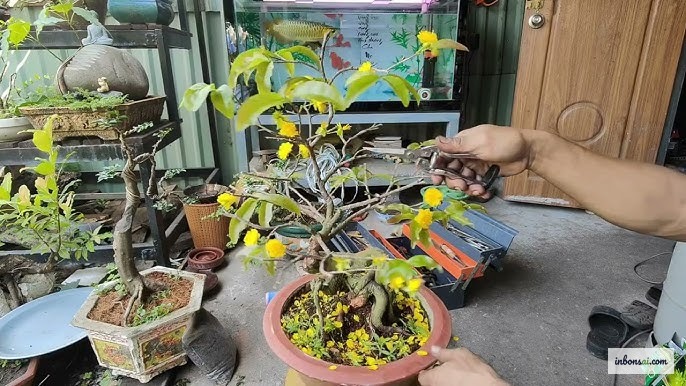
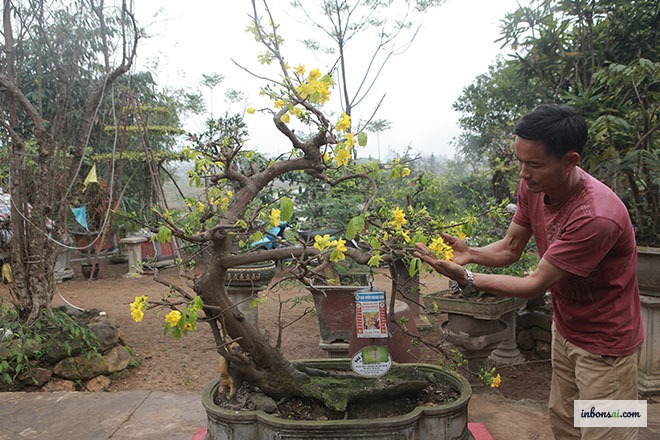
The Ochna tree is beautiful partly thanks to its elegant appearance, which few other ornamental plants can match. When speaking of Ochna, one thinks of the shape that is both graceful and flexible, like a virtuous and gentle woman. Therefore, many people believe that Ochna represents the elegance of poetry and literature, and this is probably not an exaggeration!
If we place the Ochna tree standing independently alone, we can clearly see why the ancients grouped Ochna into the set of MAI - TUNG - TRUC (Ochna - Pine - Bamboo).
Ochna resembles Bamboo in that it has a soft trunk and branches, leaves are always lush green and only change seasonally.
Ochna resembles Pine in that it lives for many years and has good endurance against heavy rain and storms, even stubbornly soaking itself in thick mist and snow throughout the cold winter which few trees can "withstand", yet they are still strong enough to resist.
It is well known that between Bamboo and Pine there is a contrast: the appearance of Bamboo is elegant, while Pine looks heavy. However, these two non-conforming appearances are contained within the Ochna tree, so the reason the Ochna tree is beautiful is that it combines the appearance of both Pine and Bamboo.
Some people also believe that besides representing poetry and literature, Ochna also represents the heroic look of weaponry.
When considering old Ochna trees that have lived soaked for many years in storms and wind so that the bark on the branches and trunk loses its softness and glossiness, replaced by countless cracks like a bunch of dragon scales... That is eloquent proof of stubbornness, of resilient endurance that seems to know no fatigue.
It is precisely for that reason that according to the Book of Songs (Kinh Thi) - a precious book collected and annotated by Confucius, Ochna is compared to the virtues of a gentleman (Quan Tu), having integrity, courage, and not easily yielding to any force...
The Ochna Trunk:
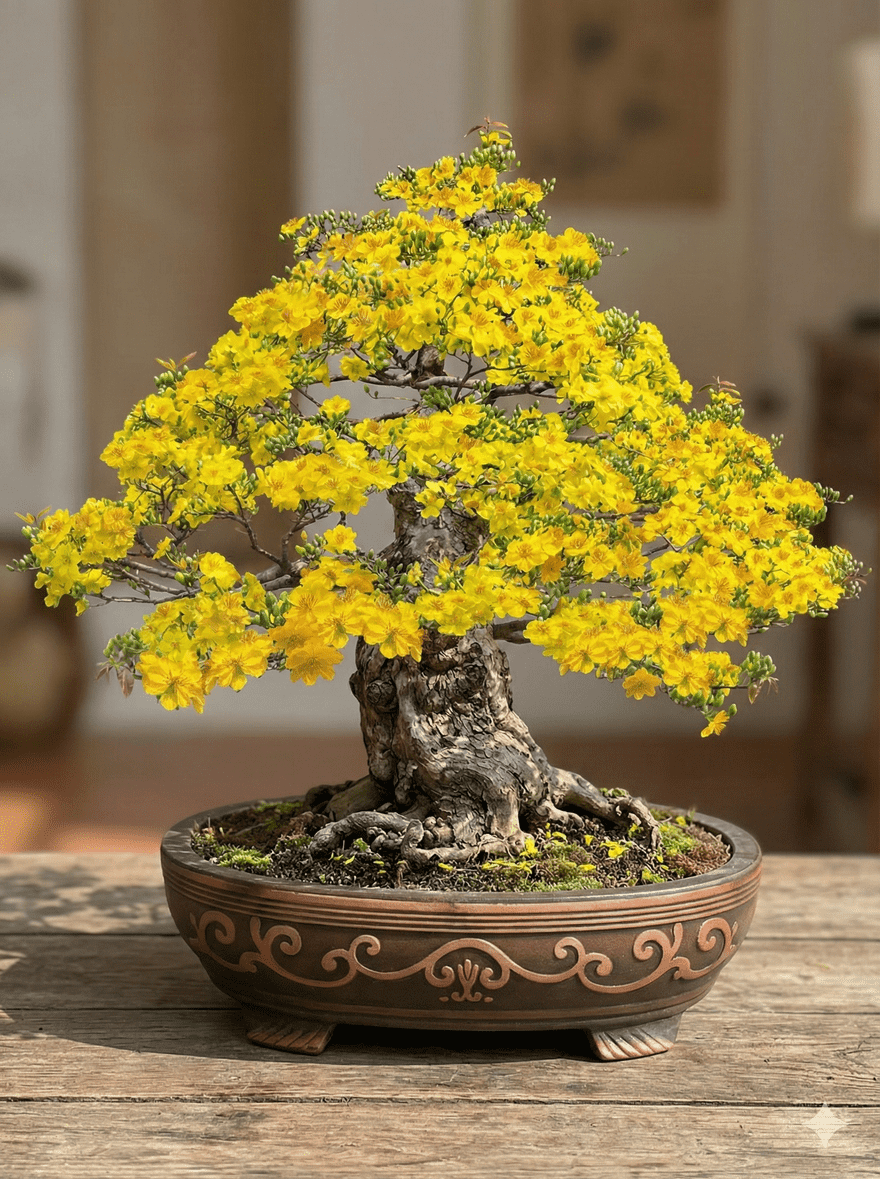
The elegant beauty of the Ochna trunk lies in the fact that when young, the trunk is slender, looking fragile and weak. But thanks to that, the shape of the young Ochna tree looks soft and flexible, not as rigid as the Pine.
When the Ochna tree is old, the trunk girth is large but the shape is slightly curved, representing the leaning posture of an old person with a bent back due to the burden of high age.
At the end of the trunk is the root part: when the tree is old, the root is large, creating a majestic stance but also imbued with a heavy look, no different from an old person with tired knees and weary legs who is no longer capable of running here and there. Moreover, at the root collar, a few large roots appear radiating in many directions, crawling crookedly on the pot soil surface to stabilize the stance for the trunk, creating a solid position for the tree. And that image has created poignant emotions for viewers when associating it with their own approaching old age.
The Ochna Branches
The elegance in Ochna branches is the flexible arrangement between large and small branches intertwined as if they want to cling to each other. But the arrangement of branches must be harmonious, must have a change in direction so as not to confuse the viewer's eyes.
Young branches can be placed next to old branches, but young branches must have smooth bark while old branches become rough to create reasonableness, in accordance with nature.
A branch is called beautiful when it is not kinked, nor broken at the tip. Branches growing at the base must be longer than those above them to create a beautiful canopy, both gentle and flexible, fitting the "Female Ochna" style which is favored by many people...
The Ochna Flower:
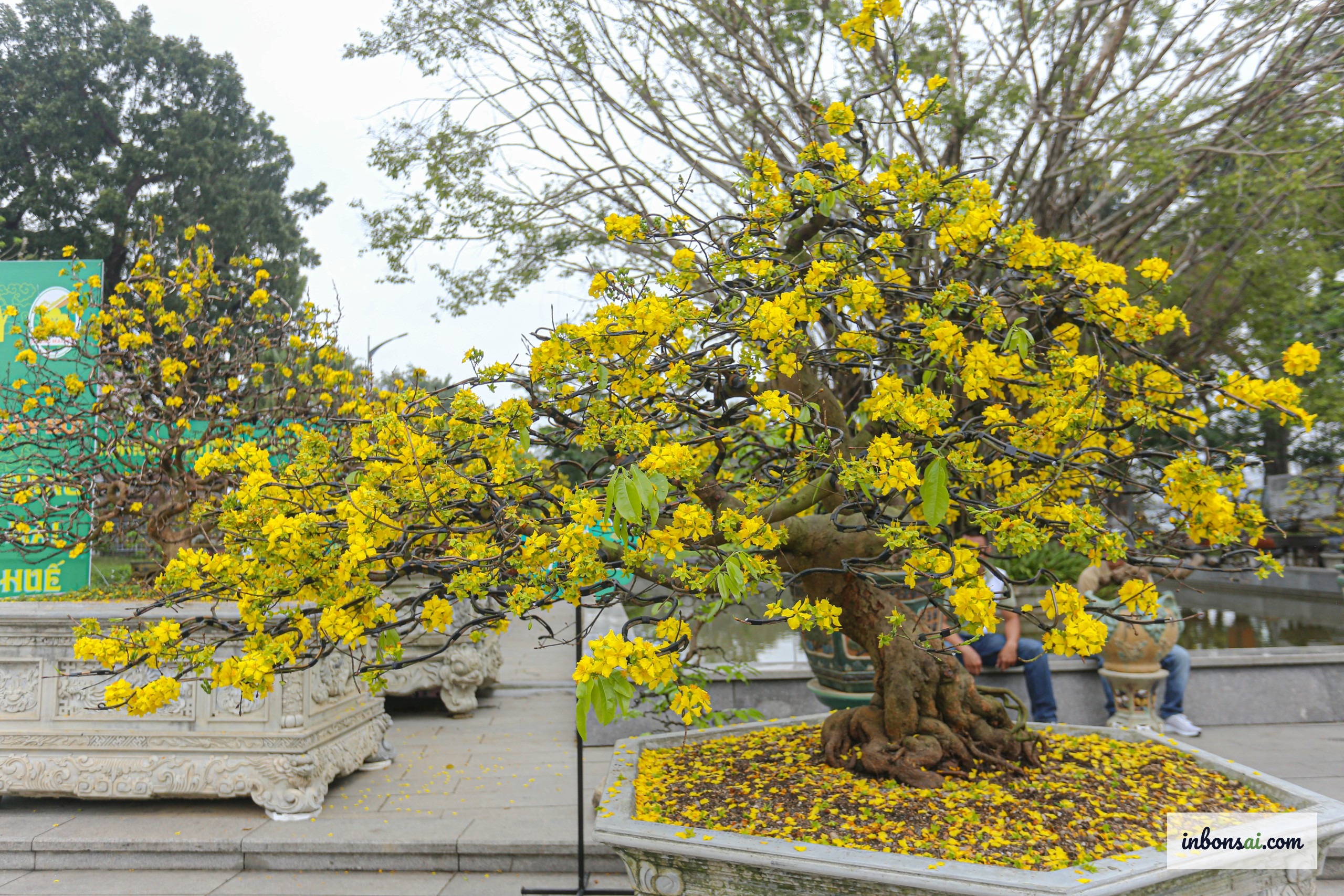
It can be said without fear of mistake, the most precious thing of the ornamental Ochna tree is the Ochna flower, and what is considered the most beautiful of the Ochna tree is also the Ochna flower.
Every year, the Ochna blooming season coincides with the traditional Tet holiday of the nation, so Ochna flowers are considered a sacred symbol of Tet. People from past to present use Ochna flowers to offer to ancestors and other Deities, according to their religion. That is the preciousness of the Ochna flower.
And the beauty of the Ochna flower is also something no one has ever denied. Although the Ochna flower does not feature the haughty look of the Narcissus, does not have the fragrant scent of the Epiphyllum, and also does not have the regal shape of the Orchid, the yellow color of the Ochna flower is evaluated by everyone as the color of hope, of luck and prosperity.
Therefore, whenever the Ochna blooming season approaches, everyone seems impatient waiting, as if looking forward to a joy, a great luck about to come to themselves, to their whole family.
The beauty of the Ochna flower, although it only has a simple plain yellow color, to everyone it is the color of hope, of wealth and nobility. Things that people of any time always wish for and expect.
However, the beauty of the Ochna flower for many ancient painters of China more than ten centuries ago was raised to another level: they believed that the sharp Ochna branches were like pieces of precious white jade skillfully cut and then assembled together, so it looked so perfect.

From there, master painters of many different generations formed unique methods of painting Ochna flowers, which no one had thought of before:
Outline Painting (Gou Le Hua - Câu Lặc Họa)
Outline Painting (Gou Le Hua - Keou lo houa) is a method of painting Ochna flowers created by a famous painter of the Tang Dynasty named Yu Si (Vũ Tích). According to this method ("Gou" means hook/curve, "Le" means carve/etch) involves drawing the shape of the apricot blossom first and then coloring it to completion. Later, many other famous painters such as Teng Chang You (Đằng Sương Cát), then Xu Xi (Từ Hi), Li Si Xun (Lý Tư Huấn) contributed to transforming it to be more magical.
Boneless Painting (Mo Gu Hua - Một Cốt Họa)
Boneless Painting (Mo Gu Hua - Mou Kou Houa) is a method of painting Ochna flowers initially created by the famous painter Teng Chang You (Đằng Sương Cát), later supplemented to perfection by Xu Chong Si (Từ Sùng Tự) born in the Song Dynasty, grandson of Xu Xi (Từ Hi), and Liu Chang (Lưu Thường) also of the Song Dynasty. The Boneless Painting method ("Mo" means not have, "Gu" means bone) is the opposite of Outline Painting in that it does not need to draw the shape of the flower first but paints immediately with color powder, without ink outlines. At first, each color would be painted on top of each other. But later Liu Chang thought of a way to mix colors together to paint once and was accepted by the majority of contemporary artists.
Flying White Painting (Fei Bai Hua - Phi Bạch Họa)
Flying White Painting (Fei Bai Hua - Fei po houa) is a flower painting method created by the famous painter Chen Chang (Trần Thường) born in the Song Dynasty, considered a strange way of painting. Accordingly, when painting flowers, whatever the flower, the petals are left in original white, not colored like the usual painting method before, but the petals are outlined with the true color of that flower. For example, painting a yellow Ochna flower, the petals are left white, but the surrounding outline is yellow. The viewer only needs to look at what color the surrounding outline of the petal is to visualize the true color of that flower...
Splashed Ink Painting (Po Mo Hua - Phát Mặc Họa)
Splashed Ink Painting (Po Mo Hua - P’ouo mouo houa) is a method of painting flowers first created by the famous painter Cui Bo (Thôi Bạch), also known by the alias Zi Xi (Tử Tây), born in the Song Dynasty. It is known that at first this famous painter applied many different painting methods, but finally created his own unique way of painting flowers, which is Splashed Ink Painting. Later, this painting method was responded to by many other famous painters such as Mi Yuan Zhang (Mễ Nguyên Chương), also known as Mi Nan Gong (Mễ Nam Cung), and Shi Zhong Ren (Thích Trọng Nhân) also born in the Song Dynasty.
The Splashed Ink Painting method is a way of coloring flowers normally, but then adding special ink dots to make that flower stand out...
At the same time, there were many famous painters with a special talent for painting Ochna flowers and other fruits and flowers looking like real ones, because they utilized all three factors: Spirit (innate talent), Subtlety (creating techniques), and Ability (responsibility with work) such as Xia Wen Yan (Hạ Văn Ngạn), Huang Quan (Hoàng Thuyên), Liu Dao Chun (Lưu Đạo Thuần), Zou Fu Lei (Trâu Phục Lôi), Wang Mian (Vương Miện)...
Tags
#golden-ochna#how-to-choose-ochna#elegant-beauty-of-ochna#how-to-evaluate-beautiful-ochnaGet bonsai guidance every week.
Fresh care guides, styling notes, and bonsai inspiration delivered to your inbox.