
Spice Vegetable
CHIVES
(Allium tuberosum)
Chives are a popular spice vegetable used in daily life. Used for cooking soup, pickling with bean sprouts, and eaten raw.
Spice Vegetable
Care Notes
Water Needs
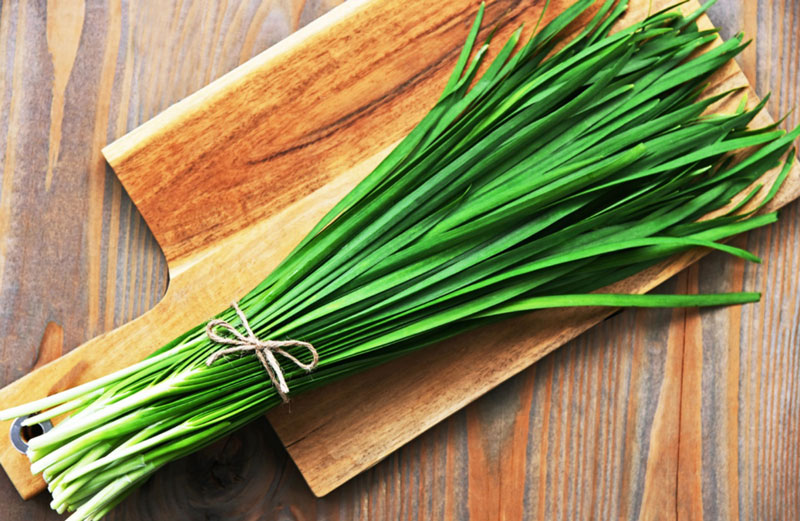
CHIVES
Allium tuberosum
1. Bio Characteristics
Herbaceous, slender, 20-30cm tall. Shallow roots. Flat leaves, white flowers.
2. Uses
Cooking soup, eaten raw, cough remedy, digestion.
3. Cultivation
Season Oct-Nov (or Sep). Light loam, sandy soil.
I. USES
Chives are a type of spice vegetable commonly used in daily life. Used for cooking soup, pickling with bean sprouts, and eaten raw. Wonton noodles cannot be without chives.
Chives are used to treat coughs and improve digestion, etc. According to folk experience, chives should be used in spring. Chives also have antibacterial properties like other onion and garlic species. Chives have a special taste.
Both the bulbous stem and leaves of the chive plant can be used.
II. BIOLOGICAL CHARACTERISTICS
- Stem & Roots: Chives are herbaceous, slender, 20 - 30cm tall. The bulbous base (true stem) is smaller than that of onions. Shallow root system with many adventitious roots, distributed in the topsoil; roots cannot tolerate drought or waterlogging.
- Leaves & Flowers: Leaves are flat, narrow, thick, with pointed tips. Flowers are white, growing on a long stalk, with some flowers clustered like an umbrella. Seeds are small and black.
- Climate: Chives prefer cool climates, can tolerate cold; suitable temperature for growth is 20 - 25°C. Requires strong light.
- Soil: Chives love moisture but cannot tolerate drought or waterlogging. Requires loose soil, active irrigation.
III. CULTIVATION TECHNIQUES
1. Planting Season
Suitable planting season is from October to November; early season can be planted in September. Chives can be grown in multiple seasons per year.
2. Soil and Fertilizers
Soil: Must be plowed carefully, loose, free of weeds; light loam and sandy soil are suitable. Before planting, expose soil to sun to limit weeds and pathogens.
Bed Preparation: Bed width 1.1 - 1.2m, 0.20 - 0.25m, furrow 0.25 - 0.30m.
- Organic (rotten): 1.5 - 2.0 tons (or 25-30kg bio-organic)
- Urea: 15 - 20kg (Do not overuse inorganic nitrogen)
- Potassium chloride: 13 - 15kg (or 100kg kitchen ash)
- Superphosphate: 25 - 30kg
* Method: Basal application of all organic fertilizer, superphosphate, with 1/3 urea and 1/3 potassium. Apply in furrows or on bed surface. Mix fertilizers well with soil before planting.
3. Seed Preparation
- Chives can be grown from bulbous stems (asexual) or seeds (sexual).
- Usually grown from bulbous stems. If so, trim roots and discard substandard bulbs before planting. Plant 3 - 4 bulbs per cluster.
- If grown from seeds, sow like onions. When seedlings have 4 - 5 true leaves, transplant them, 3 - 4 plants per cluster.
4. Spacing & Density
Spacing 15 x 15cm; density about 40,000 clusters per 1,000m².
IV. HARVEST & PRESERVATION
- Harvest: Mostly leaves are consumed. After harvest, young leaves grow strongly, allowing multiple harvests. First harvest 50 - 60 days after planting. Subsequent harvests every 30 - 35 days. Leave 3 - 4cm of stem at the base when harvesting.
- Seed Production: Remove weak plants. Spacing 10 - 15cm, top dress with potassium and phosphate for bulb development. When leaves whither, harvest clusters, tie in bundles, dry in mild sun or shade for next season.
Conditions
Fertilizer per 1,000m²: Organic (rotten): 1.5 - 2.0 tons (or 25-30kg bio-organic) Urea: 15 - 20kg (Do not overuse inorganic nitrogen) Potassium chloride: 13 - 15kg (or 100kg kitchen ash) Superphosphate: 25 - 30kg * Method: Basal application of all organic fertilizer, superphosphate, with 1/3 urea and 1/3 potassium. Apply in furrows or on bed surface. Mix fertilizers well with soil before planting. 3. Seed Preparation Chives can be grown from bulbous stems (asexual) or seeds (sexual). Usually grown from bulbous stems. If so, trim roots and discard substandard bulbs before planting. Plant 3 - 4 bulbs per cluster. If grown from seeds, sow like onions. When seedlings have 4 - 5 true leaves, transplant them, 3 - 4 plants per cluster. 4. Spacing & Density Spacing 15 x 15cm; density about 40,000 clusters per 1,000m². IV. HARVEST & PRESERVATION Harvest: Mostly leaves are consumed. After harvest, young leaves grow strongly, allowing multiple harvests. First harvest 50 - 60 days after planting. Subsequent harvests every 30 - 35 days. Leave 3 - 4cm of stem at the base when harvesting. Seed Production: Remove weak plants. Spacing 10 - 15cm, top dress with potassium and phosphate for bulb development. When leaves whither, harvest clusters, tie in bundles, dry in mild sun or shade for next season. Fertilizers (per 1,000m²) 1.5-2 Tons Organic 15-20 kg Urea 25-30 kg Superphosphate 13-15 kg Potassium Growth Process Planting
Oct-Nov (Bulb/Seed)
Care
Irrigation, moisture
First Harvest
After 50-60 days
Next Harvests
Every 30-35 days