
Industrial Crops - Spices
PEPPER
(Piper nigrum L)
Pepper seeds are a very common spice used in food processing. Pepper has a spicy, attractive aroma, but is hot. Pepper stimulates digestion and increases appetite.
Industrial Crops - Spices
Care Notes
PEPPER
Piper nigrum L
1. Bio Characteristics
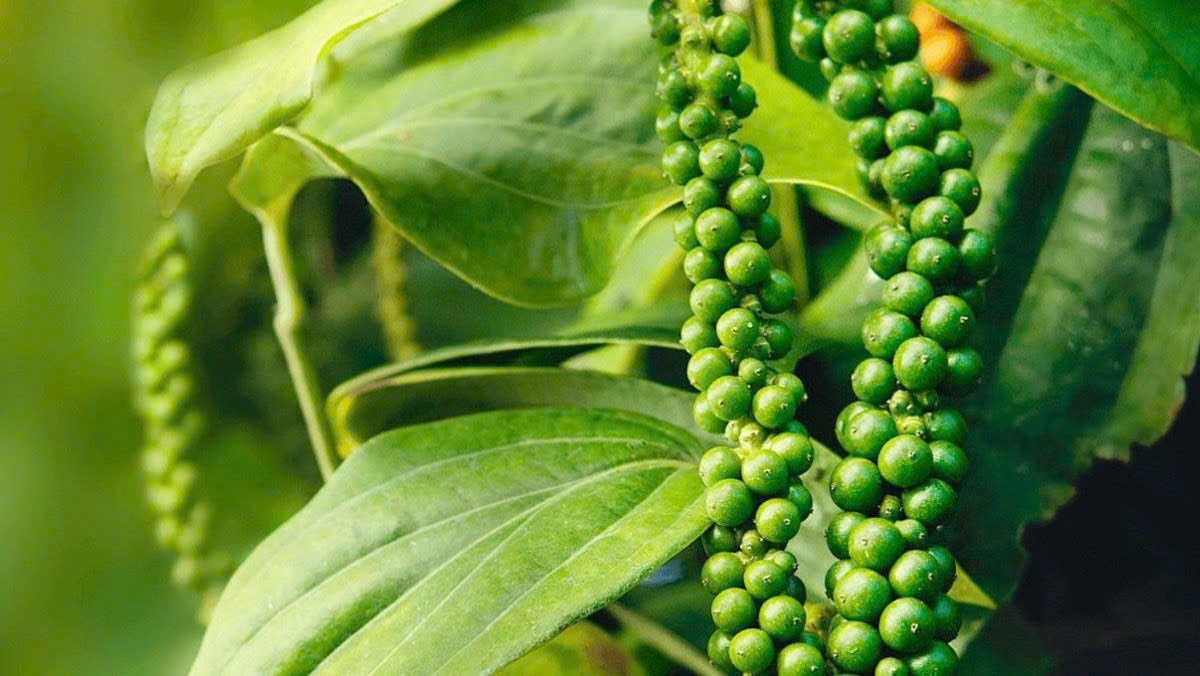
Climbing vine, roots at nodes. Betel-like leaves. Spiked flowers. Spherical fruit, single seed.
2. Uses
Common spice. Stimulates digestion. Important export commodity.
3. Cultivation
Propagate by cuttings. Needs poles. Shade trees. Regular fertilization.
I. USES
Pepper seeds are a very common spice used in food processing. Pepper has a spicy, attractive aroma, but is hot.
Pepper stimulates digestion and increases appetite. Pepper is an important export commodity.
II. BIOLOGICAL CHARACTERISTICS
- Stems and Leaves: Pepper is a perennial industrial crop, a vine climber, each node is capable of producing adventitious roots that can cling to other trees. Leaves grow alternately on the stem, similar to betel leaves, but the tip is more tapered, greener and harder than betel leaves.
- Flower and Fruit: Pepper flower clusters are catkin-shaped, one cluster has about 20 - 30 fruits. The fruit is spherical, each fruit has only one seed.
- Climate: Pepper prefers a warm climate, tolerates heat, loves moisture, but does not tolerate waterlogging.
- Soil: Soil for pepper must have a cultivation layer of 50 - 100cm thick, rich in organic matter, good drainage, pH from 5.5 - 7. Pepper can grow on many types of soil but red basalt soil is most suitable; it can also be grown on schist soil, alluvial soil, etc. Soil with a slope of 5° is suitable for growing pepper.
III. CULTIVATION TECHNIQUES
1. Season
Currently, climate change is very complex, causing many difficulties for producers. Therefore, gardeners need timely response measures. Pepper is grown mainly in Quang Tri, the Southeast and Central Highlands regions, etc. The season varies according to weather conditions in each region and characteristics of the variety.
2. Nursery, Propagation
Pepper is propagated mainly by runner vines and stem vines. According to the technical process of growing pepper in Chu Se of the Vietnam Pepper Association (VPA) 2012, the standards for cuttings are as follows:
- Runner vine cuttings: Medium growth age, 3 - 4 nodes, no pests, taken from gardens over 4 years old, all leaves removed when nursing.
- Stem vine cuttings: Medium growth age, healthy, 4 - 6 nodes, nodes with good clinging roots. Cuttings taken from pepper gardens 12 - 18 months old or from pepper propagation gardens. Cuttings taken 25 - 30cm from the ground, removing the young tip, cutting off some leaves on the cutting.
Pot size 25 x 15 - 16cm, 8 - 10 drainage holes at the bottom. Plastic bags can be used. Each pot contains 1.5kg of topsoil with 0.5kg of decomposed manure and 30g of super phosphate. Mix ingredients well before planting. Each pot plants 1 - 2 cuttings, at least 2 nodes must be deep in the soil. Water daily to keep moist and provide shade.
When cuttings sprout, gradually reduce shade and increase light. When cuttings have 4 - 5 leaves, plant them in the production garden.
3. Fertilizer (per root/year)
According to documents from the Vietnam Academy of Science:
- First year: 10 - 15kg decomposed organic manure; 150g urea, 300g super phosphate and 80g potassium chloride (KCl). Apply all organic manure and phosphate into the hole before planting; apply 1/3 of nitrogen and 1/3 of potassium before planting. Must mix fertilizer with soil.
- Second year: 15kg decomposed organic manure; 200g urea; 300g super phosphate and 120g potassium chloride (KCl).
- Third year: 15 - 20kg decomposed organic manure; 300 - 500g urea; 450 - 500g super phosphate and 200g potassium chloride (KCl). Do not abuse inorganic nitrogen fertilizer.
4. Spacing, Density
Spacing and density depend on variety characteristics, type of pole and number of vines/pole.
- Dead poles (wood, concrete): Spacing 2 x 2.5m to 2.5 x 2.5m, density about 1,600 - 2,000 poles/ha.
- Se Pepper variety: Spacing 1.8 x 2m/1 pole/2 vines, density about 2,700 - 2,770/ha.
- Live poles (jackfruit, coral tree): Should be planted 1-2 years in advance, dig deep to limit root competition.
5. Planting Technique
Dig holes 40 - 50cm deep/diameter. Arrange rows East-West. Place pot 20 - 25cm from pole, remove plastic bag, cover with soil. For concrete/wood poles, can plant 2 cuttings or 2 pots/pole; dig 6-7 holes around pillar, edge 12-15cm from pole. Brick pillars 70-80cm diameter.
6. Care
- When vine is 25-30cm, tie to pole. Tie every 5-7 days (rainy season), 10 days (sunny season).
- When 1-1.2m high, cut leaving 3-4 nodes, leave 2 branches. Second pruning when branch has 10 nodes (leave 4-5 nodes). Prune 4-5 times for strong canopy.
- Year 1: After 1-2 months, apply 50% urea + potassium. Apply remainder at end of rainy season.
- Year 2: Apply all organic, 50% urea + potassium. Remainder in middle of rainy season.
- Year 3: After harvest continue similar application.
IV. HARVEST AND PRESERVATION
- Season: Fruit ripens 8 - 10 months after flowering. Harvest focused from December to April. Can harvest 2 times/year.
- Classification: Black pepper: Harvest unripe fruit (some red/yellow). Dried skin becomes wrinkled black. Spicier and more fragrant than white pepper.
- White pepper: Harvest fully red ripe fruit, remove skin, seed is ivory white/gray.
- Red pepper: Harvest extremely ripe fruit, incubated. Secret method to keep red color. Export value 3-4 times higher than black pepper.
Growing Conditions
Nursery / Planting
Runner / Stem cuttings
Care Year 1-2
Water, shade, fertilize
Flowering - Fruiting
Ripe 8-10 months after flowering
Harvest
Dec - Apr