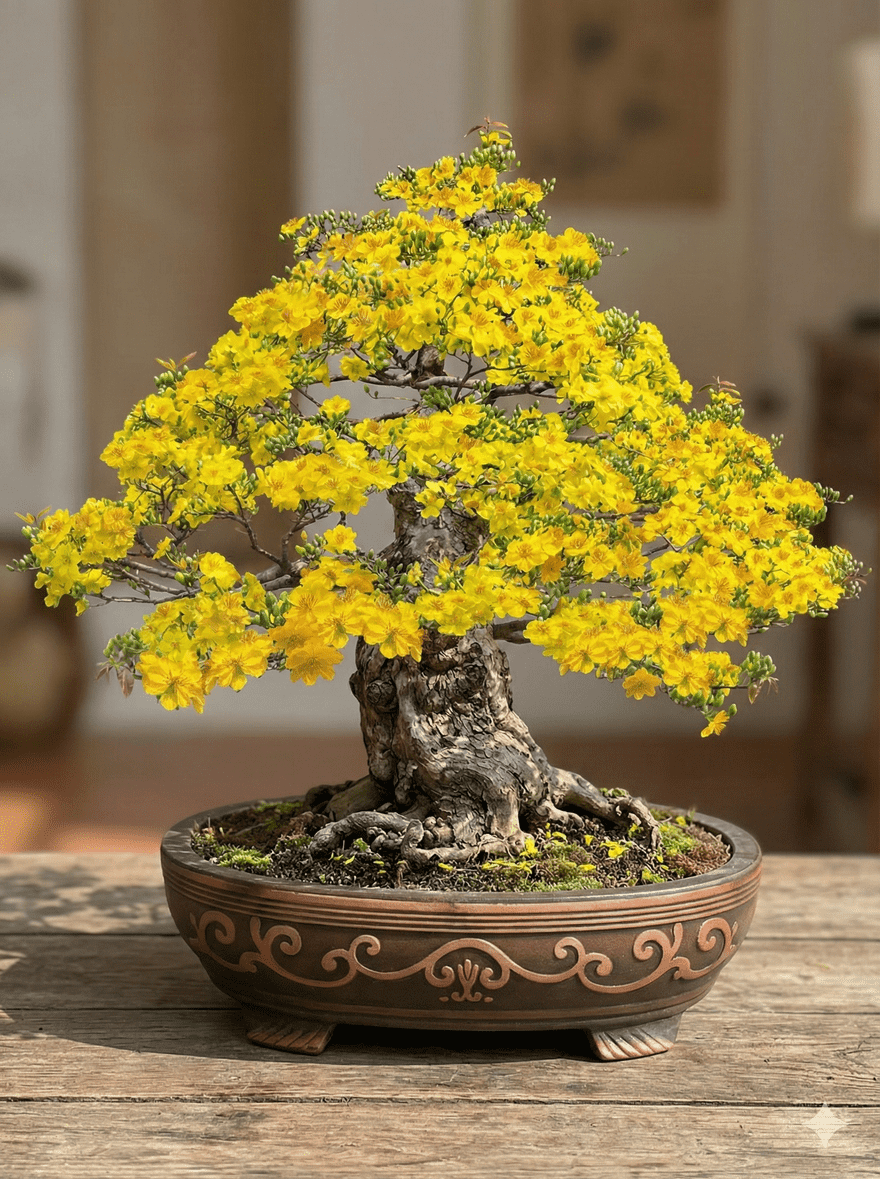
How to plant Yellow Mai suitable for climate and ecological conditions
InBonsai Team
December 8, 2025 · 9 min read
YELLOW MAI TREE AND ECOLOGICAL CONDITIONS
Just like some other crops such as rubber trees and coffee trees, the Yellow Mai tree also adapts to a specific ecosystem.
The Yellow Mai tree is better adapted to regions with a hot and humid climate than regions with a cold climate and prolonged rainy and stormy seasons.
In our country, the Yellow Mai tree only grows well and blooms in the right season (during the Lunar New Year) if planted in the South. Specifically, from Nha Trang inwards. If planted in the provinces of the North Central and Northern regions, where there is heavy rain, flooding, and prolonged cold seasons, although the Mai tree can still live, it generally does not grow well and often blooms out of season.
That is why we are not surprised to learn that most of the beautiful Mai trees that people in the Northern provinces buy to display during the three days of the Lunar New Year are brought from the South. Every year, usually in the last month of the Lunar calendar, many flower merchants in the North are present at famous Mai gardens in Thu Duc, Go Vap, Long An, Tien Giang… to buy in large quantities and transport them back by truck to resell.
This is similar to how there are still many peach blossoms from the North displayed in the South during Tet.
Soil conditions:
The Yellow Mai tree is not too picky about soil. Loam, sandy soil, basalt red soil, clay loam, and alluvial soil are all suitable for planting Mai, provided that the soil is not too poor in nutrients that other plants cannot live.
The area for planting Mai requires sunlight, must not be shaded, and must be high and dry, not prone to waterlogging due to heavy rain or high tides.
In other words, the soil for planting Mai requires a thick topsoil layer and avoids soil with a very high groundwater table. As you know, the taproot of the Yellow Mai tree is quite long, penetrating deep into the ground to absorb nutrients to nourish the tree, thanks to which the Mai tree grows well and develops strongly. If the taproot encounters rising groundwater, it is easily susceptible to rot, causing the tree to become weak and gradually die…
Therefore, since ancient times, our ancestors have had experience planting Mai only on high ground such as mounds and hills, and avoiding planting in low-lying areas that are often flooded during the rainy season and high tides.
The weakness of the Yellow Mai tree is that if the base is submerged in water for a day or two, the entire root system will rot, leading to the foliage on the tree turning yellow and withering, and the tree will die standing, with no way to save it!
In low-lying areas, high beds must be raised to plant Mai. How high or low the bed needs to be depends on how thin or thick the topsoil layer of the planting land is.
If the garden is large and needs to plant thousands of trees, many beds must be created. The length of each bed depends on the land or the preference of the grower. The width of each bed needs to be 1m-1.2m wide enough to plant a few rows of small Mai, and 1.2m-1.5m wide enough for two rows of large Mai. Between two adjacent Mai beds, there needs to be a walkway wide enough from 0.5m-0.8m for the grower to move back and forth when watering, fertilizing, and caring for the Mai garden.
In addition, in the Mai garden, even if there are high enough beds, it is also necessary to dig many ditches to both store water for irrigation and serve as an effective drainage system to rivers and streams when the garden is at risk of flooding due to rain and high tides.
In low-lying areas, if you do not raise beds or build high mounds to plant (planting a small quantity), you can plant Mai in pots. Although it costs money to buy pots, planting this way is convenient. During the rainy and flooding season, we only need to raise the pot high to avoid waterlogging for the Mai.
However, suitable land for planting Yellow Mai trees requires not only planting on high ground (or on beds) but also meeting the following conditions:
Light conditions:
The Yellow Mai tree is very tolerant of sunlight, including direct sunlight. Therefore, if the Yellow Mai garden is spacious and open, the Mai tree will grow better.
How well or badly the Yellow Mai tree grows depends on the number of hours of sunshine in the year. If the number of sunshine hours is around 2,000 hours, it is suitable for the growth of the Yellow Mai tree. Conversely, areas with less than 1,600 hours of sunshine per year are not suitable for its growth.
Therefore, if Mai is planted in a shaded place, or if the garden is surrounded by many tall trees casting shadows and blocking light from entering the garden, the Mai tree will grow slowly, become stunted, and at the same time be more susceptible to attacks by pests and diseases such as fungi.
However, the drought tolerance of the Yellow Mai tree is limited. If there is a long drought, the soil cracks, and there is no adequate and timely watering, the Mai tree will wither and die.
Only in cases such as when the tree is still small, or Mai is in the stage of cuttings or grafting, can it not withstand direct sunlight. They will die when planted in places with high sunlight intensity. These weak Mai trees, if planted in pots, should be moved to a cool place such as under the canopy of trees or on the side of the house during the intense harsh sunlight hours from 10 am to 3 pm. Outside of that time, we can move the pot back to its old position. The percentage of sunlight that these weak Mai trees adapt to is only about 30 percent.
If planted in the garden soil, to reduce the intensity of sunlight for the Mai garden, especially in the dry season, we should make a shading net overhead.
It should be added that for Mai trees that have just been repotted, although they are large Mai, in the first half of the month we should also move the pot to a cool shaded place so they can recover quickly. Mai just repotted is Mai used for display during Tet for a long time, so it has lost strength, now it has old roots cut off, rotten roots due to diseases, and branches pruned, so the health of the tree is even more damaged. Therefore, during the time needed to “recover”, they cannot withstand intense sunlight, so for the first few weeks, the sun must be shielded, and then let them be exposed to the sun gradually…
Temperature conditions:
The Yellow Mai tree is suitable for regions with hot and humid climates, preferably from 25°C to 30°C. If the temperature is higher than 30°C continuously for many days, the Mai tree still lives well. But, if the temperature drops below 10°C, the Mai will grow poorly, almost barely surviving. That is why Yellow Mai trees planted in the South grow better than Mai trees planted in the North of our country.
Wind conditions:
The Yellow Mai tree is suitable for planting in open land with light winds under 3m/second. If Mai is planted in areas with frequent strong winds, storms will adversely affect the growth and development of the Mai tree.
In the face of strong winds, including storms, it is not easy to uproot or topple the Mai tree, because this tree variety has a good root system, especially the taproot which is quite long and penetrates deep into the ground to help the tree stand firm. However, strong winds will cause the foliage to wither because the water stored in the leaves evaporates quickly, and the air humidity in the garden also decreases rapidly. If this situation persists, it will make the tree ragged and lose strength… If there are strong winds during the season when the Yellow Mai blooms, it will cause the flower buds to develop slowly and fall off a lot.
However, if Mai is planted in land that is not ventilated, it is also disadvantageous, as the tree is easily susceptible to fungal diseases and bacteria having a good opportunity to attack.
Rain conditions:
Yellow Mai is suitable for lands with two distinct rainy and sunny seasons in the year, like the climate in the South of our country.
During the rainy season from April to the end of October, the tree is developing, so there is a lot of rain. When the season comes for Mai to change leaves and bloom near Tet, requiring warm sunshine and dry weather, it coincides with the dry season (from November to the end of March next year). Thanks to that, the Mai tree blooms in the right season, and every house has Mai flowers with brilliant yellow colors to display during Tet. As you know, even in the South, any year when the weather changes in the last month of the year, with a lot of rain and cold, that year the Mai will not bloom on the right day.
In short, although the Yellow Mai tree is very easy to plant and easy to live, and not too picky about soil, this tree variety only grows well in suitable ecological conditions. The Yellow Mai tree adapts well to the living environment in the South of our country, where the year has two distinct rainy and sunny seasons, little storm and rain, and also little cold…
Related Posts
How to plant Yellow Mai suitable for climate and ecological conditions
Why is the Yellow Apricot Tree considered a precious ornamental plant?
Methods for Creating Scenery for Lingnan Rockery Bonsai (Penjing)
Ling Nam Bonsai Trunk Styling Method (Grow-and-Prune Technique) (Part 1)
Methods for Creating Root Styles for Lingnan Bonsai
Linh Nam Bonsai Collection (Part 1)
Discussing Lingnan Bonsai Art