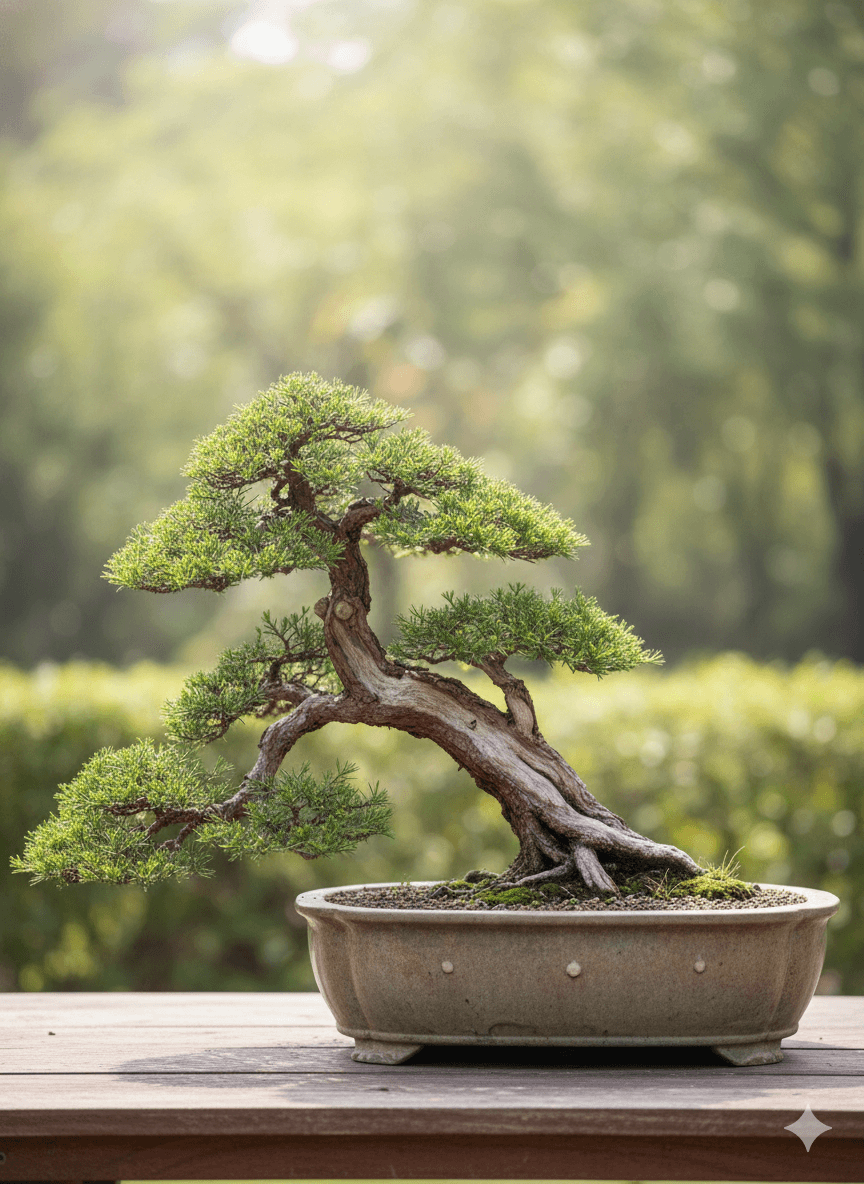
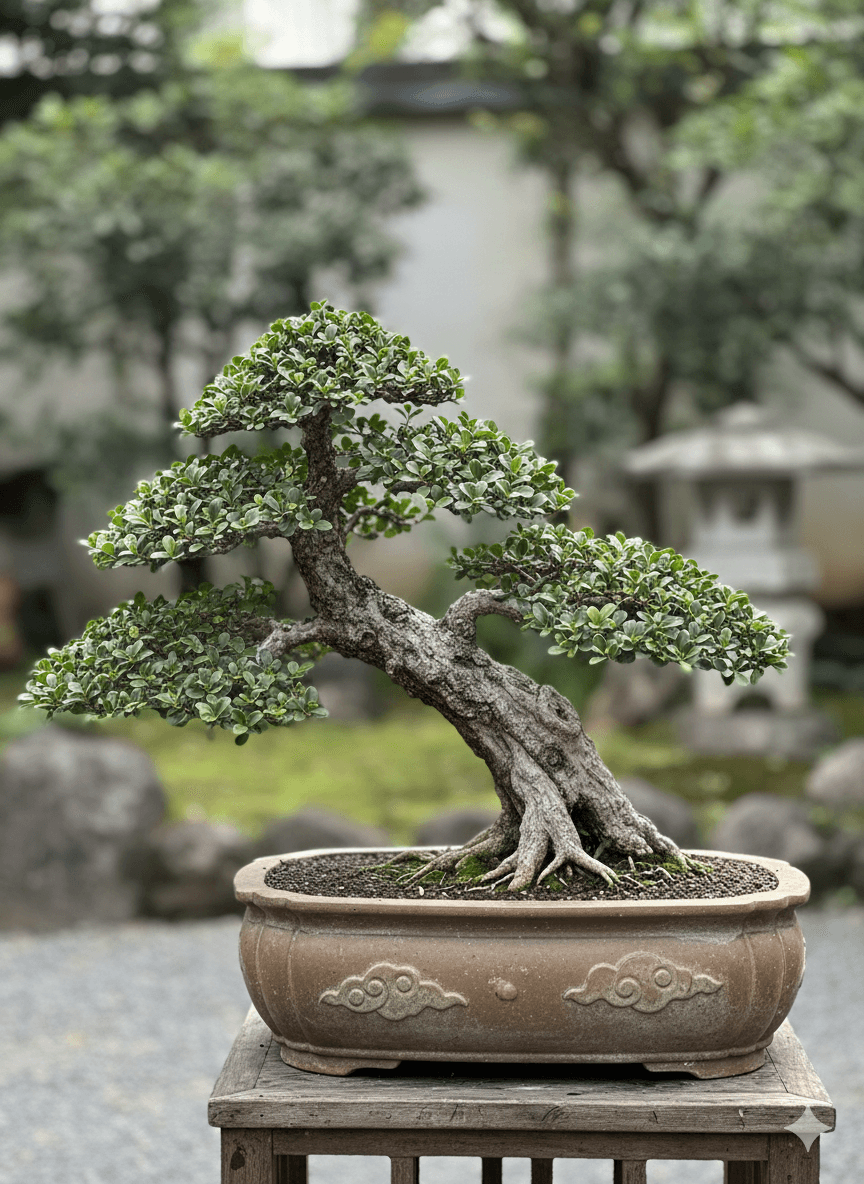
What is Lingnan Bonsai?
InBonsai Team
December 9, 2024 · 16 min read
The Art of Lingnan Bonsai
DISTINCTIVE FEATURES OF LINGNAN BONSAI ART
The art of Lingnan Bonsai pursues elegance and grace, transcending the mundane. It embodies both the scenery and the spirit, placing great importance on latent beauty, ambiguous beauty, and deep inspiration. It values using real scenery to highlight the imaginary, combining the real and the virtual; it emphasizes layers and depth to achieve “the finite becoming infinite, the bounded becoming boundless.” It is something that can be understood intuitively but not described in words, captivating people and inspiring wild associations and endless meaning.
Lingnan Bonsai always excels in poetic quality. Excellent works always have a magical attraction, profound and subtle meaning, causing endless contemplation. Excellent works can fully demonstrate flexible application of artistic dialectics, resolving all contradictions in the shaping of scenery, meeting the principles of artistic creation that are both diverse and unified.
1. Morphological Characteristics of Lingnan Bonsai
Beautiful Bonsai works have very strong expressive capabilities, and they can create satisfactory methods for handling empty spaces, using the virtual to replace the real, giving viewers free space for imagination. The arrangement of the landscape in these basins can reach a reasonable density, harmonious balance. In terms of rhythm, it expresses a form of “tonal rule” through changes in high and low, up and down, sparse and dense, open and closed, to convey human psychological emotions and enhance the expressive power of the work.
Excellent bonsai works have very strict requirements for spirit, avoiding rigid formulas lacking breakthroughs, focusing on capturing spirit and direction, meaning conscious arrangement to achieve “a combination of movement and stillness,” making the work vivid and musical.
In an excellent Bonsai work, the shape or color of the landscape has shades of intensity, and at the same time, it can form an asymmetrical balance. This is the “Mutual execution” of heavy and light. The proportional arrangement of the landscape in Bonsai must reach a level of harmony, balance, and inspiration, to be able to combine delicately and connect with each other. The branches in these Bonsai have beautiful shapes, some slender, some rough, slender within rough, prominent highlights, clear symmetry, wonderful forms, beautiful souls, able to express that the more hidden the scene, the more attractive the meaning; the more visible the scene, the more vague and deep the meaning. The scenery of excellent Bonsai works can show “hidden within the visible” to arouse rich associations for the viewer, thereby benefiting the new creation of artistic inspiration. Bonsai art cannot be too ordinary, nor can it be too strange. Too ordinary is uninteresting, too strange loses naturalness; achieving the ability to see the strange in the ordinary, combining realism with artistic inspiration and musicality creates an excellent work.
2. Richness in the Content of Lingnan Bonsai Art
Excellent Bonsai works can show firmness within softness, softness within firmness, achieving “firmness and softness complementing each other.” Skill and clumsiness have a dialectical relationship. In Bonsai art, skill is naturally a kind of beauty. In fact, clumsiness is also a beauty; neither can be missing. Therefore, one should achieve a mutual complement of skill and clumsiness. In the natural world, “withered and lush” both exist; in Bonsai, the contrast between “withered and lush” is also often used to symbolize the struggle between life and death, thereby showing the vitality of life. An excellent Bonsai work transmits very strong inspiration from just a small pot, achieving “seeing the big in the small,” able to express a landscape with an extremely wide range… this is even more so in miniature rockery landscapes.
The weight and size of different types of scenery in excellent Bonsai works must handle “appropriate proportions,” both reasonable and natural, yet having a comparative effect, highlighting, making the work achieve artistic effects of seeing big in a small scope, seeing far while near.
In summary, excellent Bonsai works can make viewers feel the author’s thoughts, feelings, and aesthetic level through each mountain and river, each branch and blade of grass, thereby making viewers moved by the scene, generating associations within the finite scenery of the Bonsai.
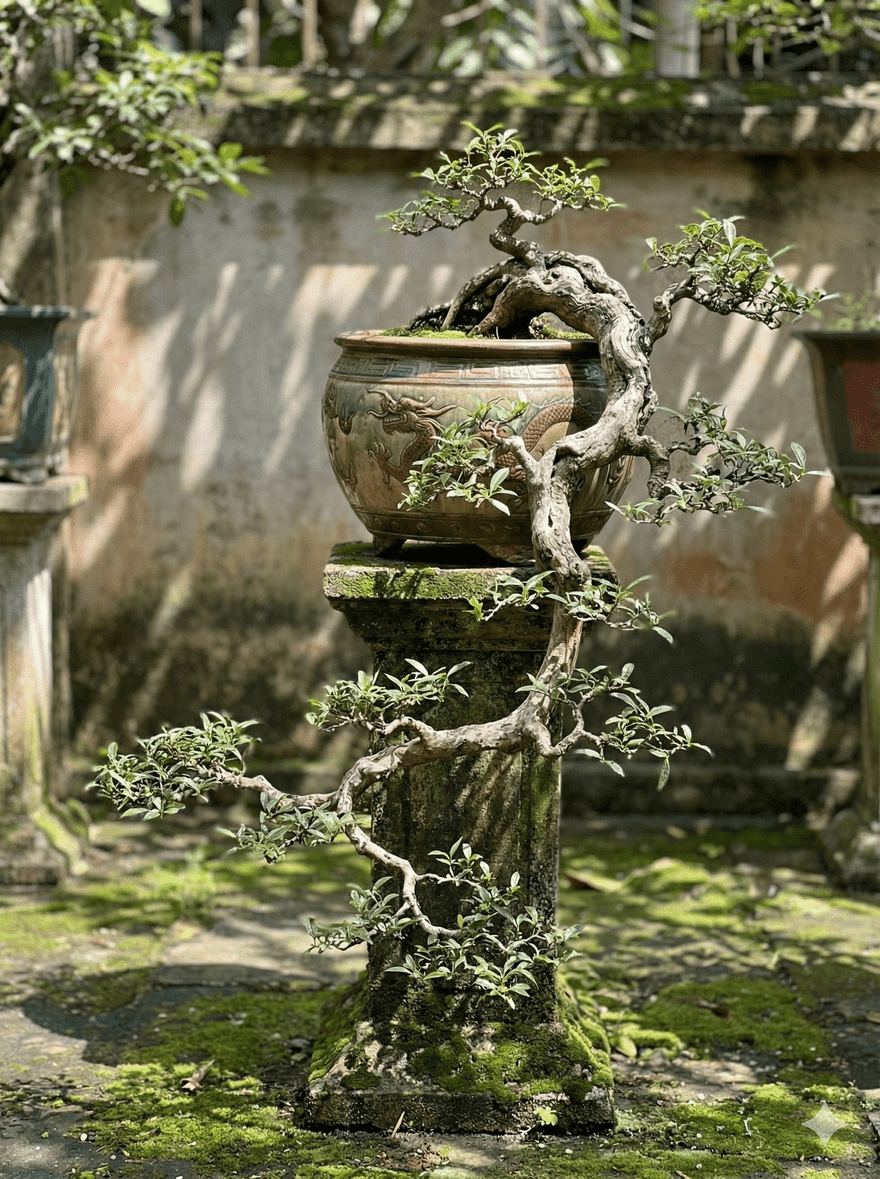
FORM AND CONTENT OF LINGNAN BONSAI
Asymmetry, anti-balance, and anti-regularity have the ability to generate more new forms on the basis of fixed forms. Chinese cultural art has always worshipped nature and advocated “Learning from Nature” (Ngoại sư tạo hóa), meaning learning from nature. In the natural world, there are always endless beauties existing in unspoken images, waiting for us to discover and learn to enrich our aesthetic knowledge, open our hearts, and create more and more beautiful Bonsai models.
1. Aesthetic Appearance of Lingnan Bonsai
The first impact of all aesthetic objects on people is naturally the form revealed from the appearance, firstly in incomparable beautiful shaping. For Bonsai art, a Bonsai work with shaping that conforms to nature and has a perfect shape appearing before one’s eyes will first move the viewer by the beauty of the Bonsai’s form, then, from those outward expressions, associate with the scenic rivers and mountains they have enjoyed, thereby becoming immersed and ecstatic in it. This is the source of artistic inspiration transmitted from Bonsai; that source of inspiration is a natural beauty. Like seeing a majestic tall pine tree in a pot, we will think of the scenery at Huangshan and Taishan; looking at a water-adjacent style Bonsai, we think of the shadow of blue waves; looking at a Banyan Bonsai with lush branches and leaves is like visiting a southern peach garden. All the above are different beautiful natural landscapes transmitted by different types of trees through unique forms of expression.
2. The Importance of Content in Lingnan Bonsai Art
Lingnan Bonsai art is not only an objective expression of “Learning from Nature,” but also pays more attention to the subjective expression of “Inner Heart Source” (Trung đắc tâm nguyên) (which must include the author’s emotional feelings), making the beauty of nature and the inner soul of people blend into one, or highlighting one’s own thoughts and emotions in the work, to borrow objects to speak for words.
These works often have a unique style and are very individualistic in form. In the relationship between form and content, people pay more attention to the beauty of charm and the beauty of content. This is the “light on form but heavy on content” we often speak of. Being light on form does not mean that form is unimportant and can be ignored, but rather breaking away from the ancient rigid patterns, creating a new, more beautiful form to convey the beauty of content, or in other words, expressing not by chasing complex details, but expressing the work’s content with simple, stylized forms, so as to achieve a blend of form and soul. This requires Bonsai artisans to have comprehensive cultivation, especially taking cultural cultivation as the basis for their creation. This cultivation is also called “Heart Source,” and it often determines the high or low level of the work. The cultural content of Chinese Bonsai art includes Confucian thoughts, leaning towards valuing ethics and morality, entrusting feelings to scenery, and also expressions of Zen Buddhist thoughts on “Emptiness and Tranquility” (quiet, deep, and infinite). Specific expressions in works often use methods of comparing fresh with withered, moving with still, hard with soft, high with low, big with small, sparse with dense, real with virtual, and seeking unity in contradictions between smooth and adverse, flowing and stuttering, high and low pitch… to proceed with creation.
3. Poetic Quality of Lingnan Bonsai
Saying Bonsai is like unspoken poetry and 3D painting is truly a principle of interconnected arts; any art form is sourced from inspiration before natural beauty, in addition to the advantage of the experience and wisdom of the author who is a writer or painter… furthermore, it is seamlessly connected with the essence of that national culture, so it is said that arts are both interconnected and can learn from and set examples for each other. Enjoying a good poem, we can entrust that poetic quality into a Bonsai work; enjoying a beautiful painting, we can also transmit inspiration from that painting into a bonsai artwork. Enjoying an excellent Bonsai work, you will be convinced by the superficial beauty on the outside, the depth full of meaning on the inside, and finally attracted and fascinated by the artistic inspiration and meaningful content that the work conveys, listening to the sounds of nature in a quiet space, experiencing the past and looking towards the future in the life cycle of the Bonsai from a sapling to old age, enjoying the joy of reaping success from spring flowering to autumn fruiting, realizing human wisdom in a quiet setting. Good poetry is like painting, beautiful painting is like poetry, beautiful Bonsai is also like poetry and painting.
ANALYSIS OF TEMPERAMENT AND MOMENTUM IN LINGNAN BONSAI ART
1. The Effect of the Existence of Temperament
The Bonsai scene is the arrangement and layout in painting construction; it is the original, an artistic idea in the process of imitation or creation. Whether it is any arrangement or layout, it is relatively stereotypical. If not driven by “Qi” (Breath/Energy), “Momentum” will have no vitality and will feel stiff and stagnant. Qi can be induced and divided into tangible qi and intangible qi. The implied meaning of “qi” in the scope of Bonsai art includes:
(1) Represents the driving force of plant growth and development, and the trend of the movement direction of nutrients and water. Like photosynthesis and phototropism of plants.
(2) Symbolizes charm; we often say tree spirit, tree momentum, temperament, expression, demeanor, and character of pine trees… for example, branches in Bonsai art are shaped like cursive script, with the aesthetic standard of “qi arrives, spirit arrives,” connecting the qi and momentum of the tree and transforming each other to create artistic effects. If only presenting and analyzing arrangement and layout, one can only prove one aspect of the structure of painting principles; furthermore, on the other hand, one needs to combine the “qi” of temperament and charm to present clearly. Arranging a Bonsai layout is not as good as a Bonsai with momentum. To achieve “momentum” in a beautiful Bonsai, one must combine “qi” with “momentum” and apply them to the Bonsai; that is the so-called “qi” and “momentum.” How to understand “qi” and “momentum” in Bonsai art? Qi belongs to yin and momentum belongs to yang. Yin and Yang is a substitute noun; it represents the philosophical relationship of opposing and unified things, relying on each other to exist, interacting, and transforming each other. For example: if heaven is yang and earth is yin, without earth there is no heaven.
Weather changes affect the changes and movements of the earth. The presentations and analyses of “qi” and “momentum” in Bonsai art follow the same philosophy of the relationship between yin and yang, a relatively profound level, not like the direct view that branches facing light are yang branches and branches not facing light are yin branches; it lies completely hidden in the content method, relying on the exploitation, explanation, and interpretation of artists. From this, it shows that with the promotion of the tree’s qi, there is a feeling of “momentum,” the so-called “momentum” that must be done, “momentum” like a storm, unstoppable; arrangement is just an original of the posture form layout, the essence should lie in “qi,” having the tree’s qi brings momentum, bringing a way to express inspiration and charm taking “qi” as the motive force.
2. The Significance of Momentum in Overall Efficiency
Human visual habit is to first look at the overall and then at other parts. The feeling of the first glance is the focus of shaping; “Bonsai Momentum” is the most intuitive and deepest impression. When enjoying Bonsai, it is no exception: start from the overall effect of the work, and then go deep into roots, trunk, branches, leaves, pot, and decoration. “Tree Momentum” is the first factor to evaluate Bonsai. Design is the expression of creation and is a process of image thinking. The design of scene creation in Bonsai must grasp the specifics of creating ideas. The design of scene creation in Bonsai must grasp the essential characteristics of the design object, arrange and organize the objects to be expressed. The best way to create a design is to redraw the image content to be expressed graphically on paper. Sometimes to increase expressiveness and artistic appeal, the layout and overall rules can use the method of exaggeration to complete. Exaggeration is the most effective way to create “Bonsai Momentum,” and empty space needs to be considered the focus of the design. “Dense but not airtight, sparse but not unstable” is the opposition and unity of contradiction, the most effective method and the key to creating Bonsai momentum. Shaping is the use of artistic techniques to create and perfect the overall image one wants to express. Shaping the Bonsai trunk is the entire process of creating and perfecting the product through optimizing and combining trunks, branches, leaves, pots, decorations, and tree frames. Moreover, the overall effect of the work is the external expression of Bonsai momentum, is a type of spirit, temperament, feature that the whole work expresses, is the combination of external lines and internal content, is the reproduction and sublimation of natural landscapes. In which content is the unity of external spirit and internal soul essence of the scenery. Looking from afar, there is a magical artistic effect like capturing the viewer’s soul, making them unable to help but stop to enjoy. Enjoying Bonsai is first about valuing its momentum. “Soaring straight up” - Like a kite meeting the wind, “Overturning rivers and seas” - Moving rivers and filling seas are all tree momentums showing off beauty to the outside. “Sitting stable like a bell, standing firm like a pine,” “Smooth thanks to spring rain, warm like newly refined jade,” these are static momentums hidden inside. Tree momentum can move people’s hearts and affect human souls. Through the expression of tree momentum to go deep into the artistic concept, improving artistic quality is the key issue to affirm whether the work is successful or failed.
3. Forms of Expression of Bonsai Momentum
Tree momentum is everywhere. All appearances of things have “Momentum” hidden inside and “Momentum” shown outside. “Momentum” and “Attitude” exist depending on each other, “Momentum” and “Charm/Luck” blend into each other both outside and inside. Strong, lush tree momentum has overflowing vitality; welcoming guest tree momentum is elegant and polite; rolling tree momentum is like “Thirty thousand feet high current pouring down”; majestic, magnificent tree momentum moves the blue sky; magnificent tree momentum hanging precariously like a rock swooping down from a high mountain peak; super strange tree momentum is noble, soaring, transcendent, free from worldly dust… too many to count. The momentum of Bonsai - Ornamental Plants is a physical, tangible image that can be watched, touched, and felt.
4. Morphological Characteristics of Bonsai Momentum
Bonsai Momentum is formed from Volume Sense, Motion Sense, and Force Sense. Volume Sense is produced from weight and volume, so large-scale works displayed in exhibition yards always bring everyone a particularly eye-catching feeling. Motion Sense is produced from everyone’s observation of moving objects. Movement will definitely have characteristics; when viewers see similar or analogous movement again, they will understand “Motion Sense,” understanding Force Sense through Motion Sense. This is the harmonious combination, close unity between Motion Sense and Force Sense to create “Momentum.”
5. Relationship between Momentum and Force of Bonsai
Force is the extension of Momentum, Momentum is the gathering of Force; having Force means having Momentum. Momentum develops and moves, Force is born from that movement. A successful Bonsai work with great momentum and high efficiency surrounding it can suggest, change the feelings of the viewer, can bring a common voice, specifically speaking, it is realizing emotion from the scene, achieving the attachment and harmony between scene and emotion, the unity between external appearance and internal idea, i.e., understanding the creative intent, the theme thought of the author from the external appearance of the work, thereby understanding more deeply the meaningful content of emotion and scene that the author wants to express, finally causing the viewer to have different emotional associations, producing artistic inspiration for Bonsai.
6. How to Take Momentum and Create Bonsai Momentum
The way to take Bonsai momentum is to discover and use the inherent posture of the bonsai through repeated observation and comparison. Creating Bonsai momentum is creating tree momentum with a completely new form by artificial manual methods. As an art, Bonsai must definitely express the author’s thoughts and feelings; the author’s subjective factors play an extremely important role. The way to take Bonsai momentum is mainly to fully discover the personality and essence of the bonsai, taking that as the design idea, which means taking materials, collecting materials to determine the theme. Creating Bonsai momentum is mainly determined by position arrangement, ending method at the top, and leaving space for the trunk and branches, the overall nurturing of branches and landscape momentum. Ornamental trees in Lingnan Bonsai excel in expressing branches; that is also one of the important points for enjoyment. Strokes in Chinese calligraphy and painting can express certain feelings, can express intensity, rhythm, and tonal rules, and can even more express the momentum of the entire Bonsai scene. The use of lines for shaping is a distinctive feature of Chinese national painting. Bonsai and calligraphy are “sister arts” - basic art forms are nearly similar, so lines in Bonsai art can also express certain feelings, even reflecting specific characteristics of the era.
Modern art emphasizes expressing the beauty of structure, rhythm, and tonal rules in the work. As an art form, Bonsai must also keep up with the times. Transcendent beauty is the highest level of Bonsai art: in Bonsai creation, the author puts deep research and understanding of nature and personal thoughts and feelings into Bonsai, making the style of the work clear, reaching the level of the scene following us but not exceeding the rules; that is transcendent beauty. To reach this level, Bonsai authors must excel in applying the way of taking momentum and creating Bonsai momentum to enrich artistic effects.
Related Posts
Methods for Creating Scenery for Lingnan Rockery Bonsai (Penjing)
Methods for Creating Root Styles for Lingnan Bonsai
What is Lingnan Bonsai?
How to plant Yellow Mai suitable for climate and ecological conditions
Why is the Yellow Apricot Tree considered a precious ornamental plant?
Ling Nam Bonsai Trunk Styling Method (Grow-and-Prune Technique) (Part 1)
Linh Nam Bonsai Collection (Part 1)