Methods for Creating Scenery for Lingnan Rockery Bonsai (Penjing)

InBonsai Team
December 15, 2025 · 11 min read
Methods for Creating Scenery for Lingnan Rockery Bonsai (Penjing)
The art of ancient Chinese garden landscaping has developed to a very high level. In addition to fulfilling functional needs, creating a garden landscape is even more important for its artistic effect, making people feel relaxed and happy. This is also a way to improve and beautify nature.
Rockery Bonsai or “Miniature Rockery Landscapes” (Penjing) has a history of over 1300 years. During the construction of royal gardens from dynasty to dynasty, a large amount of material on Rockery Bonsai was accumulated for later generations to study and research.
Rockery Bonsai shrinks/condenses the entire or partial scenery of a garden into a pot. Its content and the natural landscape are the same, but this also brings certain difficulties to creativity. Therefore, the effort is in the pot, but the intention/thought is outside; creativity stems from life. Only by traveling and enjoying many famous mountains and rivers, and experiencing scenic spots firsthand, can one accumulate a large number of creative themes. When creating Rockery Bonsai, one needs to grasp it firmly/calculate carefully. At the same time, absorbing many elements such as traditional painting, gardening, and fine arts… will be beneficial when creating.
1. Common Tools
Hammer: Flat-headed hammers are suitable for processing loose stones; pointed hammers are used for chiseling holes and carving stone patterns.
Chisel: Used to create caves, stone veins, depressions, paths, and mountain peaks.
Saw: Used for soft stones, creating vertical and horizontal stone veins.
Carving Knife: Comes in flat, round, oblique shapes… and different sizes, used for fine carving on soft stones.
Small Shovel: Used for mixing cement and sand, and joining mountain stones.
Brush: Can be used to clean stones and brush away surrounding cement.
Writing Brush: Can be dipped in water to brush away remaining cement mixture after joining stone blocks.
2. Common Materials
Commonly used materials are cement, sand, and mountain stone (including soft stone and hard stone).
Sandstone: Soft stone quality, gray-brown or earth-yellow color, easy to process, sculpt, and shape; it is one of the stones often used for Rockery Bonsai, found in areas such as Zhejiang, Anhui, Sichuan, Hebei, Shandong…
Tube Stone (also called wheat straw stone): There are two types, thick and thin, with small tube-shaped holes and strange stone peaks, weird caves formed naturally; need to be especially careful when processing, easy to crumble, found in areas such as Changbai Mountain in Jilin and Heilongjiang in the northeast.
Sea Mother Stone (Coral Stone): Coral stone is a type of fossil formed from shellfish deposits. Since it is formed on the coast, it contains a lot of salt. It needs to be soaked and washed with fresh water for a period to remove the salt before planting trees.
Stalactite: Mostly white or yellowish, naturally formed into different shapes such as columns, cones. Soft quality, loose, easy to cut, found in Guangdong and Guangxi.
Wax Stone (chrismatite): Usually exists on mountains as individual stones, hard texture and cannot be processed, only the whole stone is used to create a landscape. Colors include dark yellow, light yellow, white, green… pictographic stones are even more precious.
Petrified Wood: Extremely hard, yellow-brown and gray-black color. This is also a good material for creating rockeries. Others include soft stone in Zhejiang, Turtle Cloud stone in Sichuan (like figure 5), and Chicken Bone stone (like figure 6).
Axe-cut Stone: Hard but brittle stone quality, with many different colors including dark gray, light gray, black-gray, and earth yellow. This stone has silk-like and sheet-like veins. Chiseling or cutting along those veins can process it into shapes. It can express mountain peaks with steep cliffs or high mountains blocking clouds, majestic and upright. This stone is found in the Jiangsu area.
Lingbi Stone: Hard stone quality, makes a sound when tapped. Colors include black, white, and also mixed colors such as black, white, earth yellow, green… also known as multi-colored; mostly found in Lingbi County, Anhui Province.
Ying Stone (Limestone): Found in Yingde area, Guangdong province. The stone surface is like a confusedly carved lotus, with all kinds of different veins, shimmering and magnificent, uniquely beautiful. Colors are mostly black-gray, with mixed colors in the middle such as white, light green, or white veins; the front and back are naturally formed, the back is quite flat, the front has natural veins, rich variations. Hard stone quality, difficult to process, does not absorb water. Good stones often have tall and steep shapes, many holes, rough, jagged, and natural.
3. Implementation Methods
After chiseling, sawing, and carving the stones, proceed to join the stones. Use a cement-sand mixture or cement water to stick them together. Use a brush, water, and a writing brush to clean up. But when joining, note that the stone veins should be unified, the joints small, and the color should also be consistent, leaving no artificial traces.
4. Natural Creation
Observe which parts are suitable for chiseling caves, peaks, gorges, mountain paths, slopes, cliffs, cliff sides, etc… need to understand it clearly, using different tools to perform the carving. Veins near the peak should be slender and thin, while veins far from the mountain should be large and clear.
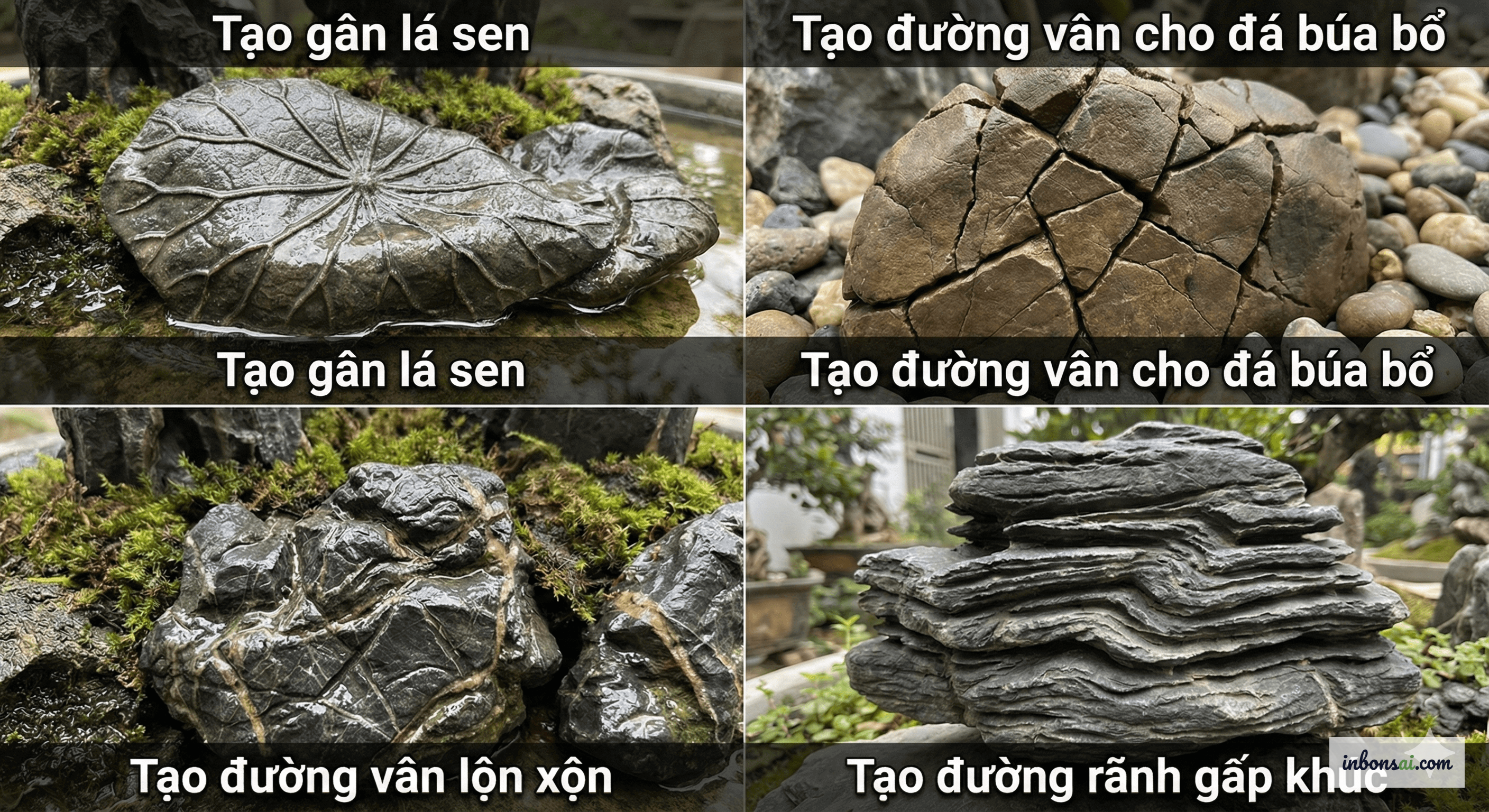
Methods for creating vein grooves: for example, creating lotus leaf vein grooves often expresses the mountain lines of granite; creating messy veins often expresses the appearance of earth mountains; tall and straight axe-cut stones with veins and sheet veins often express steep cliffs and majestic momentum towering into the clouds; creating zigzagging vertical and horizontal vein grooves often expresses the unique temperament of rock mountains. The method of creating stone grooves on Rockery Bonsai is shown in Figure 3-47.
(a) Creating lotus leaf veins (b) Creating veins for axe-cut stone (c) Creating messy veins (d) Creating zigzag grooves
Figure 3-47 Methods for creating wall grooves used in Miniature Rockery Landscapes
5. Water and Mountain Scenery
After determining the size of the pot area, if the pot has a large area, design the mountain peaks on the left and right sides of the long edge, taking 1/3 of the pot length as the center point of the main peak. One side is the secondary peak and small peaks as a background. The height of the main peak is about 60% of the pot length, which is appropriate. The height of the secondary peak is about 50% - 70% of the height of the main peak, which is relatively suitable (for reference only). The stone body usually has only one face and must have “groove” veins, and the wrinkles must follow a rule. The face with non-smooth grooves is the stone face, and the face with smooth grooves is the stone back. When completed, all faces are main faces, and the back faces are combined and disappear. Use a cement-sand mixture to stick them together. Regarding shaping, proceed to shape and arrange the layout according to the principle of many peaks, steep and precipitous high peaks, “one peak, essence of a thousand hearts; one stream, ten thousand miles of mountains and rivers”. Miniature Rockery Landscapes take mountains as the main element. Successful Miniature Rockery Landscapes must have beautiful forms and majestic, tall momentum, with landscapes having wrinkled, narrow, leaking, and transparent grooves, creating landscapes that are front and back, left and right staggered and changing. The main scenery must be prominent, and there must be a difference between primary and secondary. When creating “品” (character “Pin”) shaped rock mountains, first take the largest stone block as the main peak, arrange it in the center position slightly towards the back of the pot. The remaining stones surround the main peak, arranged on the left and right sides slightly leaning forward. Thus, the layers of rock mountains overlap, interweave and link together. The mountain grooves are solemn, solid and natural. A 3D landscape painting with beautiful mountains, rippling clear water appearing right before the eyes. The landscape in the pot must be diverse in variation, but not too revealing of artificial carving, and must conform to the laws of natural rivers and mountains. Mountains have high and low, near and far; mountain slopes have steep and gentle, long and short; peaks have towering danger; mountain ranges have softness and grace, majesty and grandeur; cliffs are steep and dangerous; caves have large and small; mountain paths are winding; trees are dense and staggered; moss and grass are beautiful and sparse; every peak, range, mountain, stream, branch, and blade of grass is extremely important. If one can “find the beauty in the draft”, one will definitely be able to create highly professional Miniature Rockery Landscapes.
At some appropriate positions, embellish by adding some figures, birds, pavilions, houses, bridges, boats, etc., which will make the rock mountain change endlessly, vividly full of life, full of poetic and picturesque quality; especially pay attention to the scale proportion and consistent color. Plant some evergreen grass and moss in the dark crevices of the mountain stones, coordinate with people, rowing boats, pond bridges, temples…, to enrich the content of the Miniature Rockery Landscape, add the breath of life, and make the content and form harmonious and unified.
6. Dry Bonsai
Dry Bonsai and Miniature Rockery Landscapes are basically similar, a combination of rock mountains and surfaces to create landscapes. The area surrounded by green mountains and flat land is a preliminary concept. Join or glue the mountain peaks together, place them on the left and right of the pot, achieving alternating high and low, natural changes, creating the artistic effect of distant scenery. Coordinating small mountains suitable for places far from the stone body and distant places has an artistic effect of open distant scenery, quiet in the hazy vision, achieving a combination of movement and stillness, full of the colors of life. On the stone body, dot with rest pavilions, slopes, figures, pavilions, and plant more small trees; plant grass and moss in dark places, plant small long-leaved trees by the roadside. Green trees form shade. The ground and mountain body are in a 4:6 ratio, creating bridges on the road at the same time, completing a beautiful landscape painting.
7. Water-Land Bonsai
Water-Land Bonsai is slightly more difficult than Dry Bonsai because it is affected by the water area. For size, the height and placement of the mountain peak must be arranged more accurately. The water part can be placed in the center or on the side of the mountain; adding mature miscellaneous bonsai trees that have been shaped on the shore of the water surface and on the dry land can express even more beauty. Or apply the form of leaning partly over water or reaching across. Planting more plants growing on cliffs at appropriate places on the mountain body will make it even more natural and vivid.
Overlapping mountain ranges, large near and small far, arranged according to a clever combination method, can allow the scene to have mountains beyond mountains, fully exerting artistic effects, expanding the vision on the lake surface. The height of the mountain, the danger of the peak, combined with figures, pavilions, paths, bridges, grass, moss, etc… the size ratio must be appropriate. In the lake, add small boats, combining stillness and movement, adding the breath of life, enhancing the artistic effect and rich connotation. When enjoying it, it makes the viewer intoxicated and longing, very valuable.
8. Examples of Creating Miniature Rockery Landscapes
Dry Bonsai. Bamboo forest and hillside combine to form a countryside tourism scene (Figure 3-48).
Figure 3-48 (Secluded Forest Bamboo Rhythm)
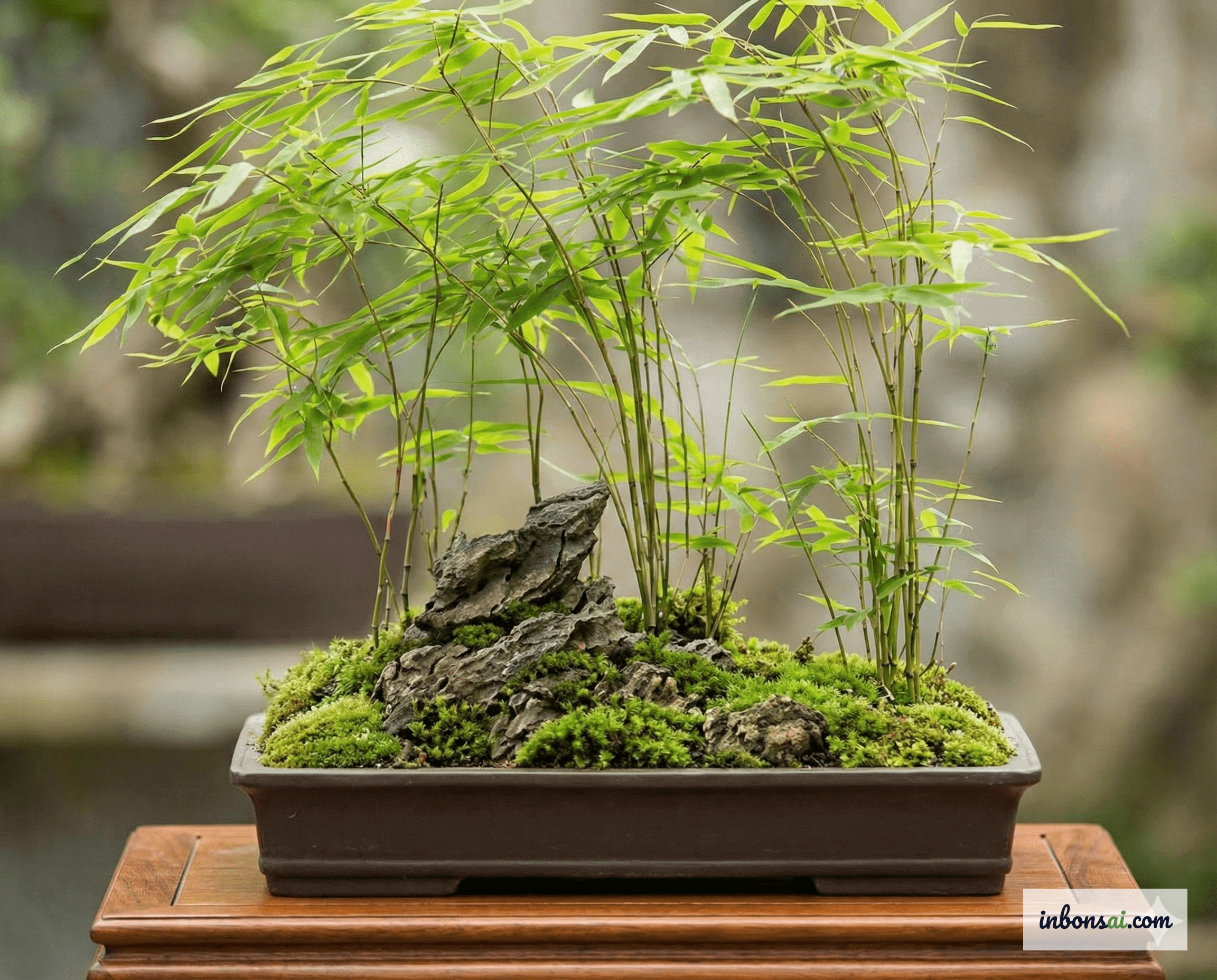
Material: Ying Stone, Asparagus fern; Pot size: Length 55cm, Width 40cm, purple sand pot.
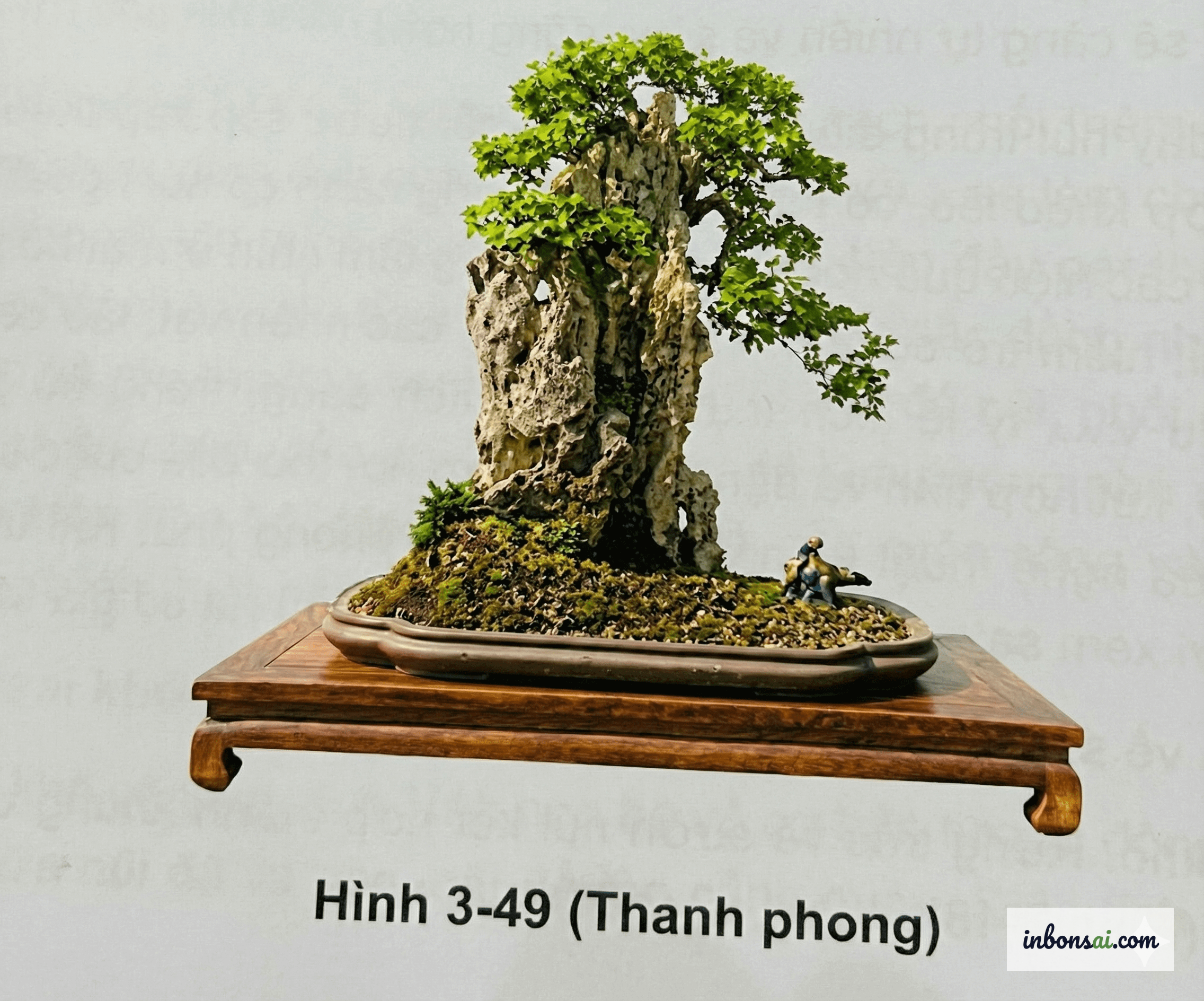
Small mountain stone with many caves, peaks and basins around the mountain, adding trees combined with figures creates a vivid real-life Dry Bonsai (Figure 3-49).
Figure 3-49 (Clear Breeze)
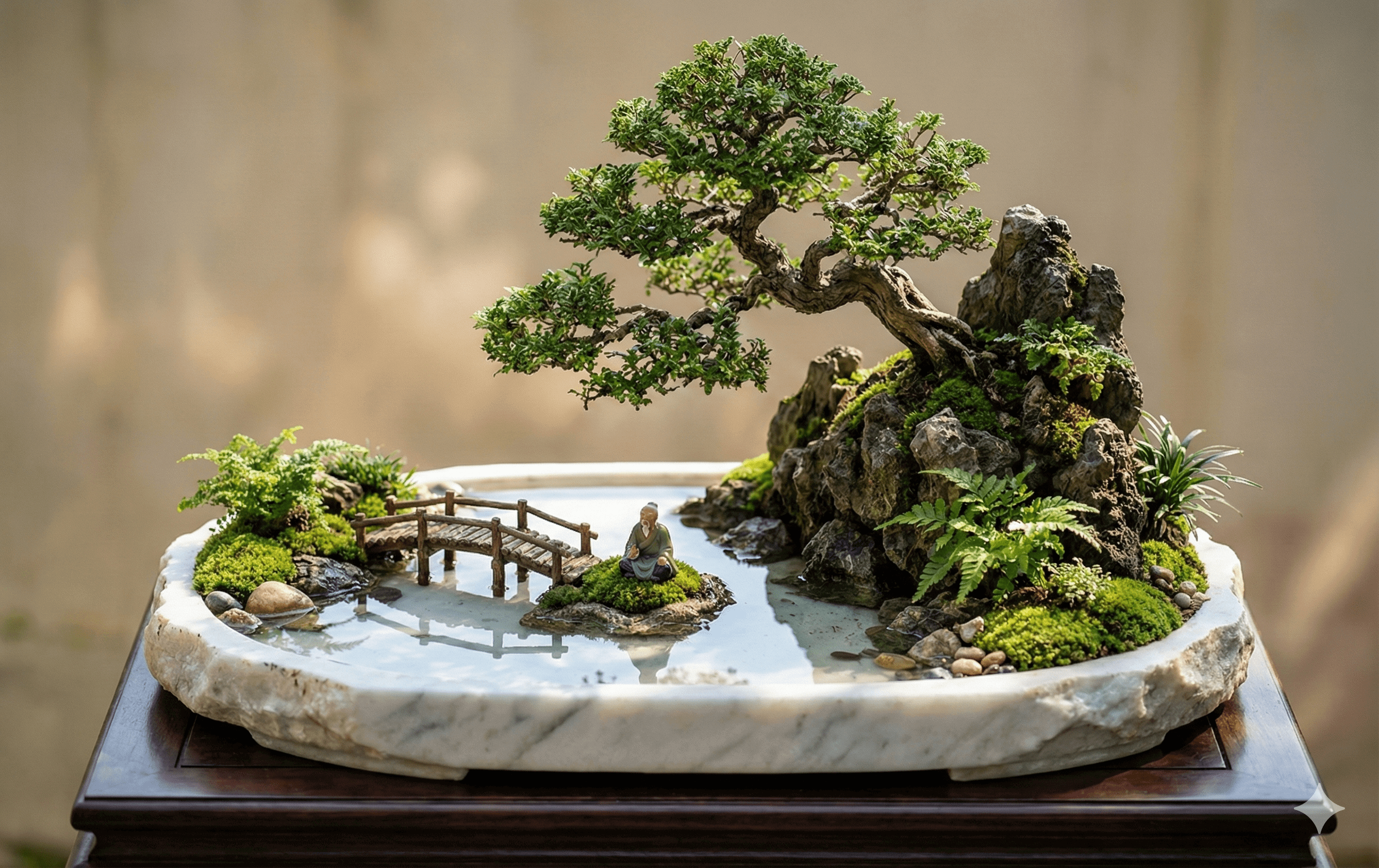
Water-Land Bonsai. A white stone pot, shallow bottom coordinated with Ying Stone, clear lake surface, a small mountain on the right combined with trees on the main peak, below the shadow is the lake surface, there is a bridge across combined with small statues. The scenery is very poetic (Figure 3-50).
Figure 3-50 (A Place of Yin Residence)
Material: Ying Stone combined with Black Bone Tea (Diospyros eriantha)
(1) Water-Land Bonsai. Shallow white cloud stone pot combined with Stalactite. This stone is unprocessed, it just happens to be a citadel. On the land of the Bonsai, Hawthorn trees are planted. It spans across the river, a boat approaches from afar, a small pavilion on the mountain peak appears and disappears, green moss, good grass, figures, reasonable layout arrangement, is a successful work (Figure 3-51, Figure 3-52).
Figure 3-51 (Flying Dragon in Secluded Ravine)
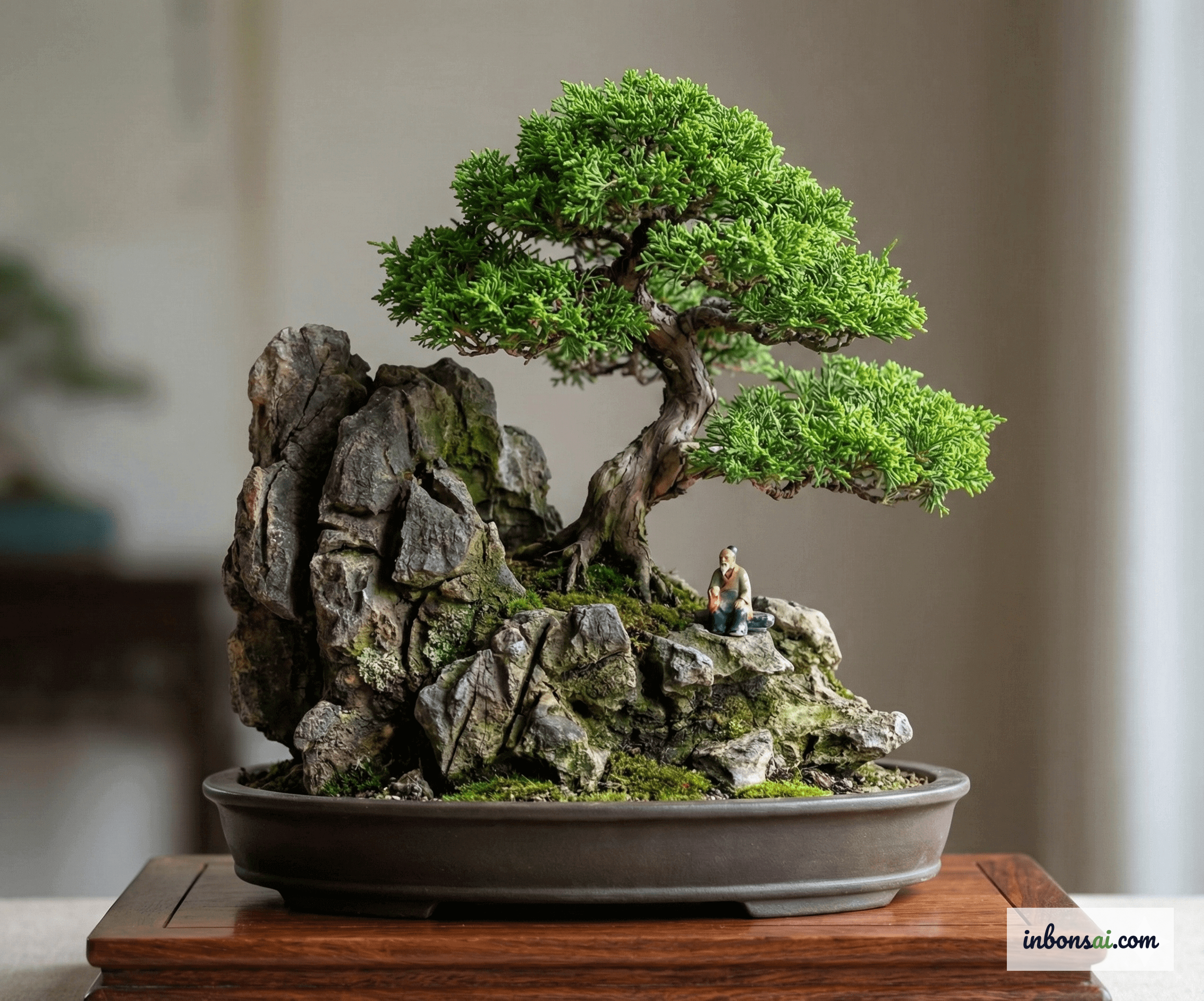
Material: Stalactite, Hawthorn, Ficus tree; Pot size: Length 100cm, Width 50cm, shallow White Cloud stone pot.
Related Posts
Methods for Creating Scenery for Lingnan Rockery Bonsai (Penjing)
Methods for Creating Root Styles for Lingnan Bonsai
What is Lingnan Bonsai?
How to plant Yellow Mai suitable for climate and ecological conditions
Why is the Yellow Apricot Tree considered a precious ornamental plant?
Ling Nam Bonsai Trunk Styling Method (Grow-and-Prune Technique) (Part 1)
Linh Nam Bonsai Collection (Part 1)