Methods for Creating Root Styles for Lingnan Bonsai

InBonsai Team
December 6, 2025 · 8 min read
Methods for Creating Root Styles for Lingnan Bonsai
The technique of creating Lingnan tree styles is divided into the root base, the trunk, the branch structure, the twigs, and the apex. Each part has a strict method of styling. In the creative process, every part must follow technical operations, then combined with painting, landscape, aesthetics, and other factors, allowing the emotions of the artisans as well as the wonderful bonsai works of Lingnan to be more clearly expressed in front of everyone.
1. Beautifying the Appearance of Roots
The method of shaping the roots is one of the “Five Departments of Scenery Methods” of Lingnan Bonsai. All five parts have their own artistic requirements and technical operations. If handled well, they will naturally exude a certain artistic quality and become a standard Lingnan Bonsai. Below is an introduction to the method of shaping tree roots.
Roots are the foundation of the entire Bonsai; they are as important as the foundation of architectural structures, closely linked to other parts and sharing the same origin. A thousand-year-old tree can maintain vitality in all harsh environments thanks to its large, prominent root system. In the process of creating roots, the transition from large roots to fibrous roots and then to claw roots must be handled to make the roots penetrate deep and firmly into the ground, weathering storms and snow, rain and wind, tempered through many years, spring to summer, autumn to winter, year after year, finally forming the posture of a tree with the large, prominent root system of an ancient tree and the demeanor of a thousand-year-old tree.
2. The Entire Root Creation Process
-
When a seedling grows into a large tree used for Bonsai, if the tree is not very ideal, it needs human modification. A tree has 4 directions, and the best one is chosen as the main face for shaping. If there are two faces, one main and one back, it is even better. Maintain 2 - 3 options, because when one side of the base is satisfactory, the trunk might not be beautiful, or the roots are normal but the trunk is beautiful. In this case, we must consider and choose the best, most reasonable option. The cross-section of the trunk is 360°, so the roots need to be reasonably distributed on the pot surface according to the tree’s posture and shape. Some tree roots grow well but many roots grow crowded and squeeze each other; this is not very good because too many roots will make the viewer feel suffocated and do not create the effect of large, prominent roots. We need to use chisels and saws to remove excess roots and try to keep large roots. Large roots coordinated with a large tree are strong enough to exude power.
-
Remove small roots lying on top of large roots or roots that cross over each other. Under the condition of ensuring that the tree can live, keep the thick, large roots, which are both expressive and consistent with natural laws. When straight roots and curved roots coexist, keep the curved roots, remove straight roots as well as crossed roots, parallel roots, single roots, and non-winding roots, keeping 3 to 5 large roots connected to the trunk is sufficient. If there are too many roots, they will be compressed and will not show the beauty of the tree’s posture. Large roots radiating in four directions, long fibrous roots connected to large roots, and winding curved roots are best; claw roots connected to long fibrous roots will create a natural winding appearance, with myriad shapes. At the same time, they combine harmoniously into a whole without artificial traces. As people often say: like “Tiger Claws” and “Dragon Claws”, when a beautiful scene is created for the root base, the upper part will freely develop and be creative.
-
When removing messy fibrous roots, consider whether the tree can survive. If you are not sure that the tree will live, you can gradually remove parts of it, dividing it to complete in 2 to 3 years. Plant the tree a little higher, pile the soil a little higher, so that later digging away that layer of mud can adjust the tree’s root system, which will be much more convenient.
-
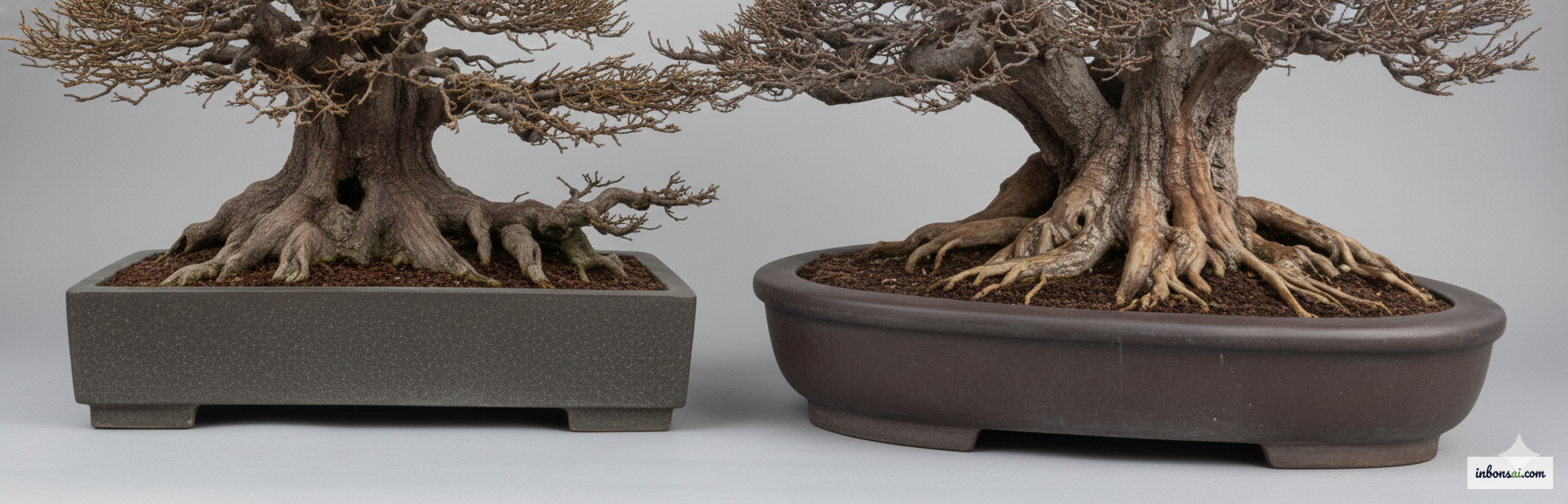
When the tree has 1 - 2 thick main roots at the bottom, it will affect the height when putting it into a decorative pot, so the creation of the main root will be divided into 2 times and completed in 2 years. Ensure the Bonsai grows well and healthy. By the third year, loosening the soil will reveal the large roots, letting sunlight shine on the large roots, which will be beneficial for the tree’s growth and root development. The large roots become more prominent, making the large roots and the small outgrowths of the trunk form a root line called “Tree Qi” (Shu Qi), like a large artery becoming stronger and more durable. (See Figure 3 below for reference)
(Figure 3a: Reference for the root system of some low-posture trees.)
3. Methods and Operations for Shaping Slanting Style Bonsai
If you want to design the trunk from a straight style to a slanting style to enhance the tree’s development direction, the trunk should be planted in a slanting direction, the roots slightly shorter at the bottom and slightly longer at the top. A slanting tree will be formed a few years later. This will express the liveliness and external beauty of the tree.
4. Methods and Operations for Shaping Cascade Style Bonsai
When a tree has enough conditions to be designed in a cascade style, first plant it in a pot or in the ground. By the second year, dig it up, cut off a part of the upper root system, then use a tile or metal object to block it, preventing roots from growing in all directions, making the roots grow as desired. If during growth the roots cross each other, arrange or cut them; if roots grow upwards, cut off a part, and bury the rest in the ground, which will make the new roots grow thicker. After 2 to 3 years of renovation, the shaping of the roots and trunk of the cascade style tree will be completed.
5. Grafting Method to Supplement Roots
When roots are missing in a reasonable position, we can perform root grafting. After 1 year, if the rootstock has survived, use a tree of the same species to supplement the roots. Use a scion with a diameter of 1 - 2cm and cover with mud for a year, cut a V-shaped cut 6 - 8cm long on the side of the rootstock, the width of the cut mouth matches the size of the scion and must be grafted tightly together, ensuring the trunk of the rootstock and the scion match evenly. After firmly fixing with 2 small iron nails 2 - 3cm long, wrap with electrical tape to avoid contact with water. 60 days later, remove the tape to observe if the graft union has healed. If growth is normal, the upper part of the scion can be cut off after 120 days. At this time, the root and trunk of the grafted tree have become one. To make the roots grow faster, add a little fertilizer in a suitable position around the tree.
6. Examples of Root Styling Methods in Bonsai
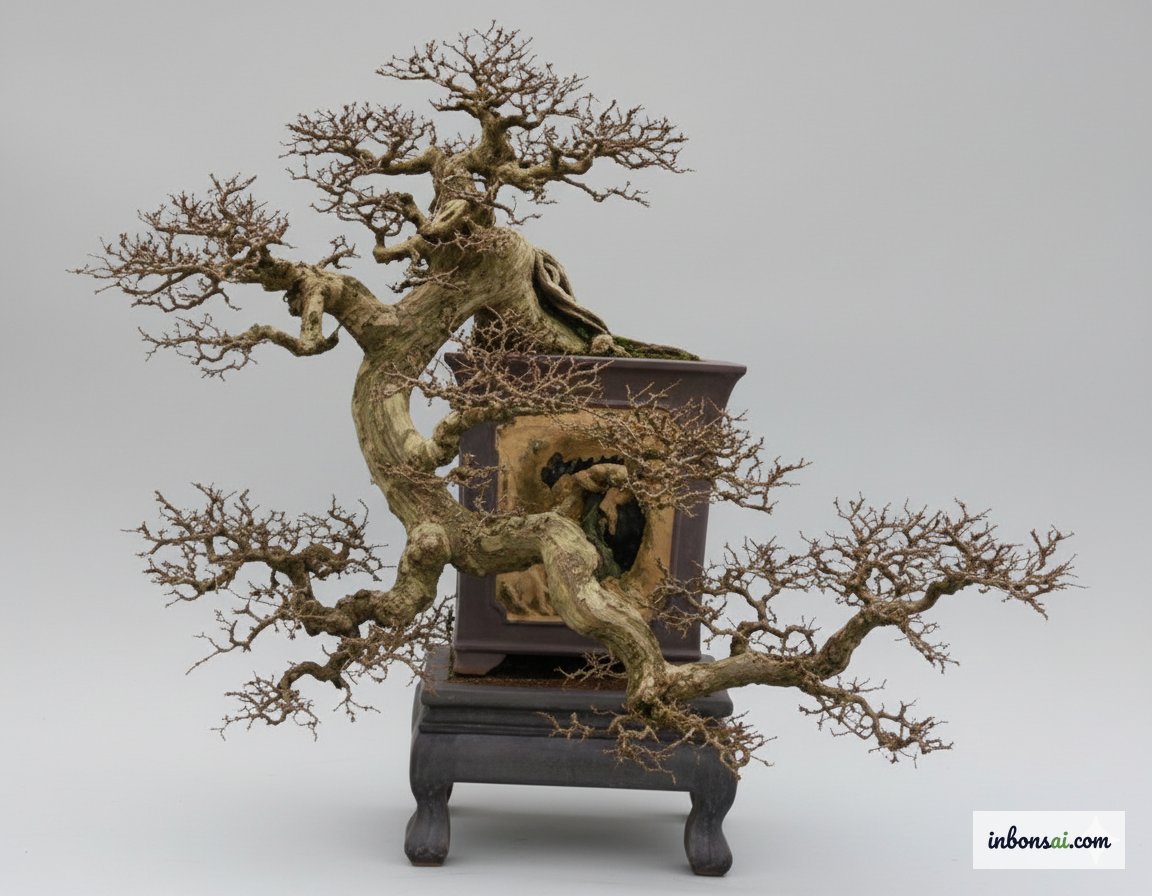
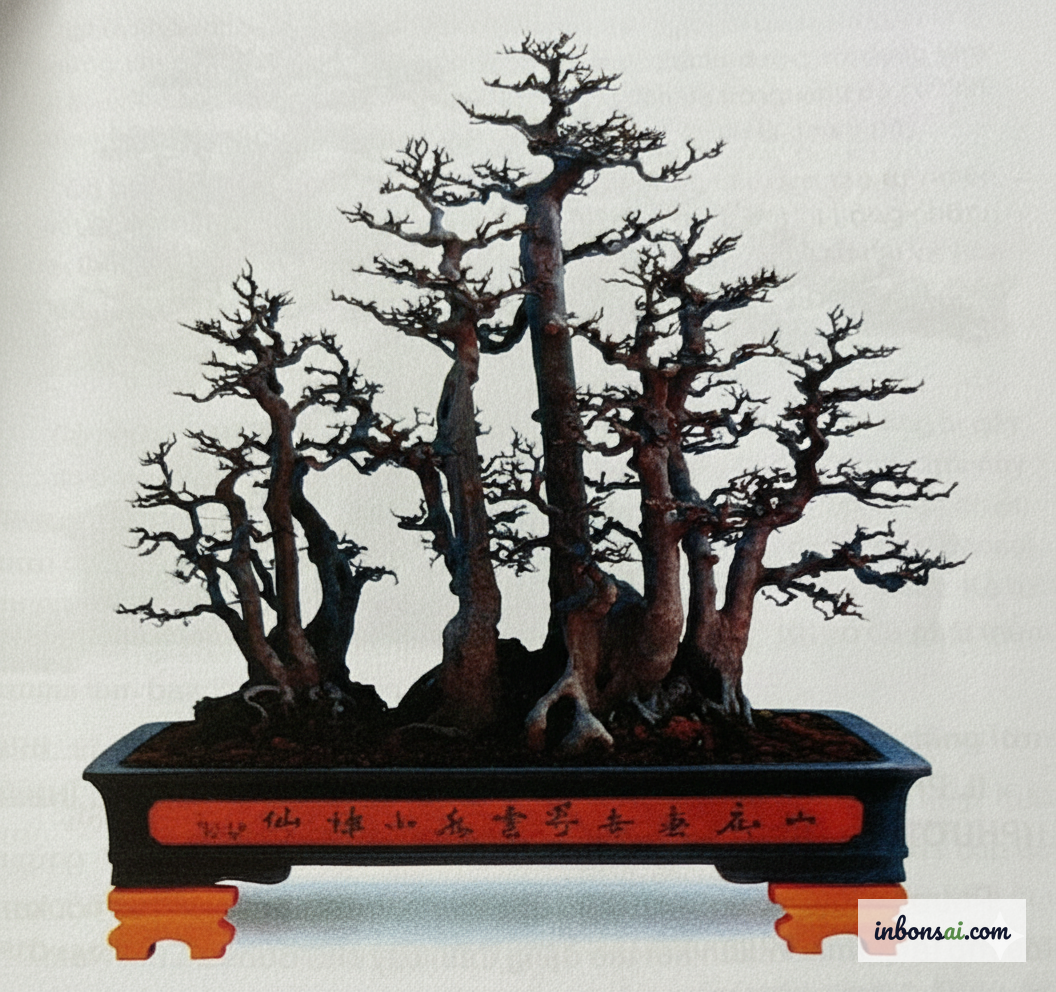
Elm pot with cascade shape. Initially, the tree lacked roots on one side, then was cared for and developed using the grafting method.
(Figure 3-1: (Ascending Dragon Exiting the Gorge), Type: Elm – Garden length 85cm)
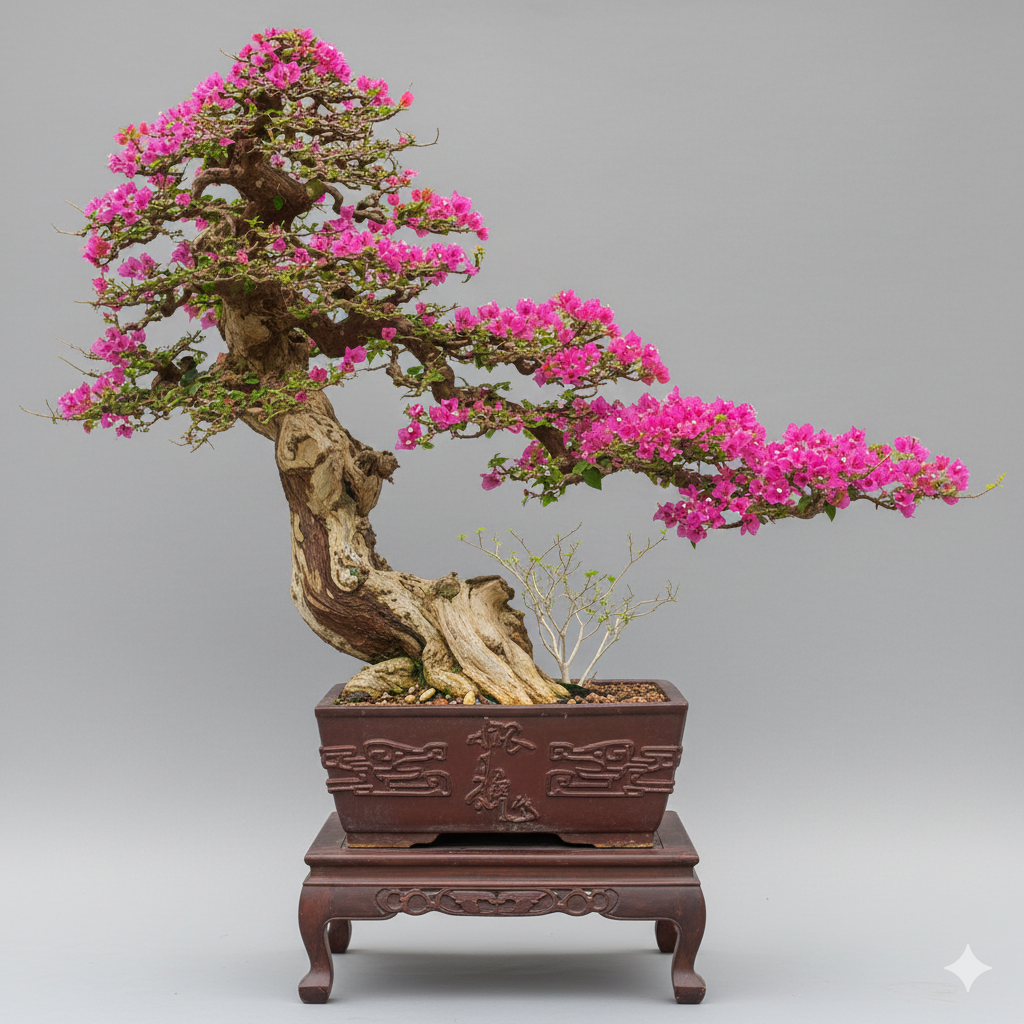
- Bougainvillea Bonsai. It was originally a straight tree style with a slightly twisted apex. During the creation process, the tree was planted in a slanting direction, the lower roots (left side) were kept shorter, the base on the right side was kept longer. Firmly fix the main trunk, after modification and creation, it became a slanting style tree, full of liveliness, elegance, and beauty. (See more Figure 3-2a)
(Figure 3-2, Type: Bougainvillea – Height 120cm)
- Pot of Hackberry trees with connected roots. During the creation process, place the main trunk together with the roots horizontally in the soil, graft seedlings in necessary positions, so that they have both thickness and slenderness, clear secondary roots, forming a clump style with connected roots. Based on the principle of arranging branches in the art garden of the rule “near is big, far is small”, bringing a low effect interlaced with deviation, exuding natural beauty and together enhancing the brilliant beauty.
(Figure 3-2a, Pot of Hackberry trees with connected roots)
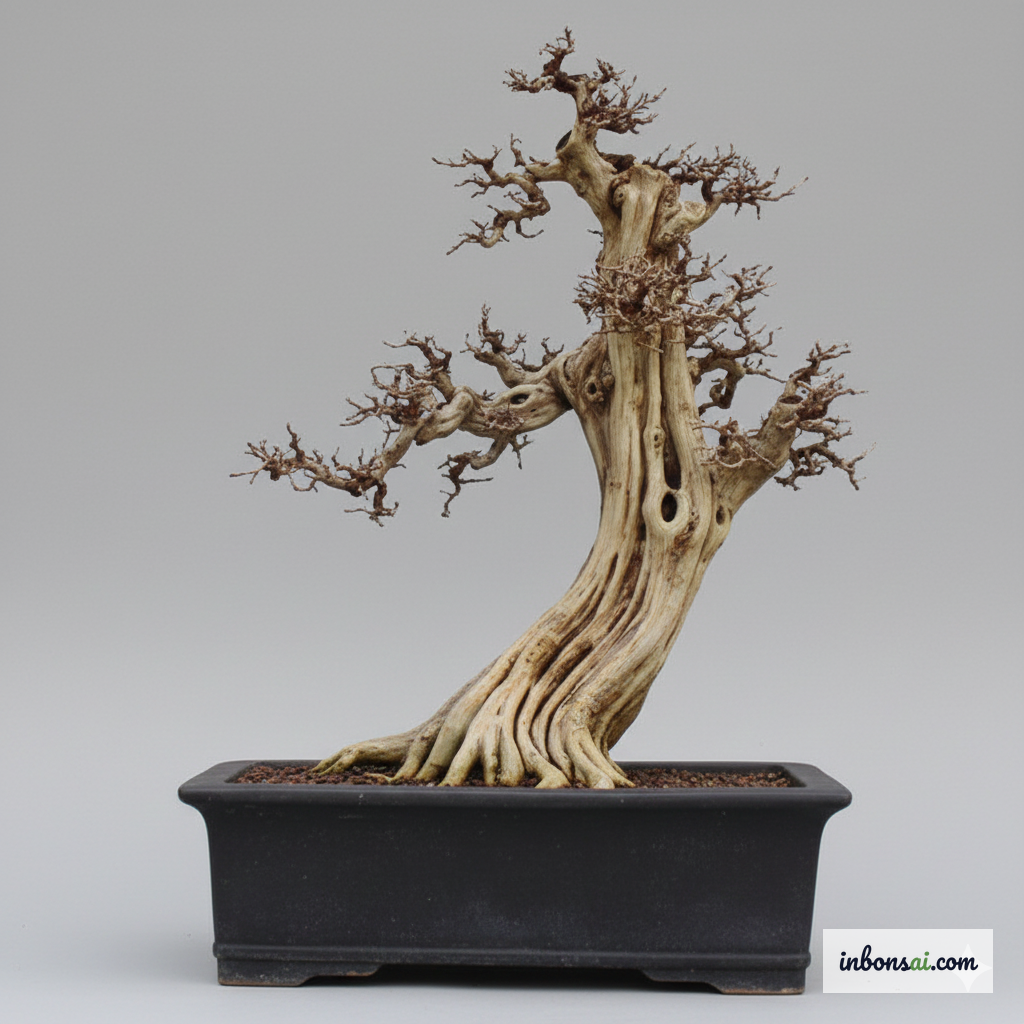
- Pot of Ficus with 2 trunks. When creating Bonsai, cutting off small roots, excess roots, and crossed roots brings the current effect. Especially emphasize that artificial traces must be lost, achieving an effect that is both natural and extremely beautiful. This takes a lot of time to shape.
(Figure 3-2a, Pot of Ficus with 2 trunks)
Related Posts
Methods for Creating Root Styles for Lingnan Bonsai
Methods for Creating Scenery for Lingnan Rockery Bonsai (Penjing)
What is Lingnan Bonsai?
How to plant Yellow Mai suitable for climate and ecological conditions
Why is the Yellow Apricot Tree considered a precious ornamental plant?
Ling Nam Bonsai Trunk Styling Method (Grow-and-Prune Technique) (Part 1)
Linh Nam Bonsai Collection (Part 1)