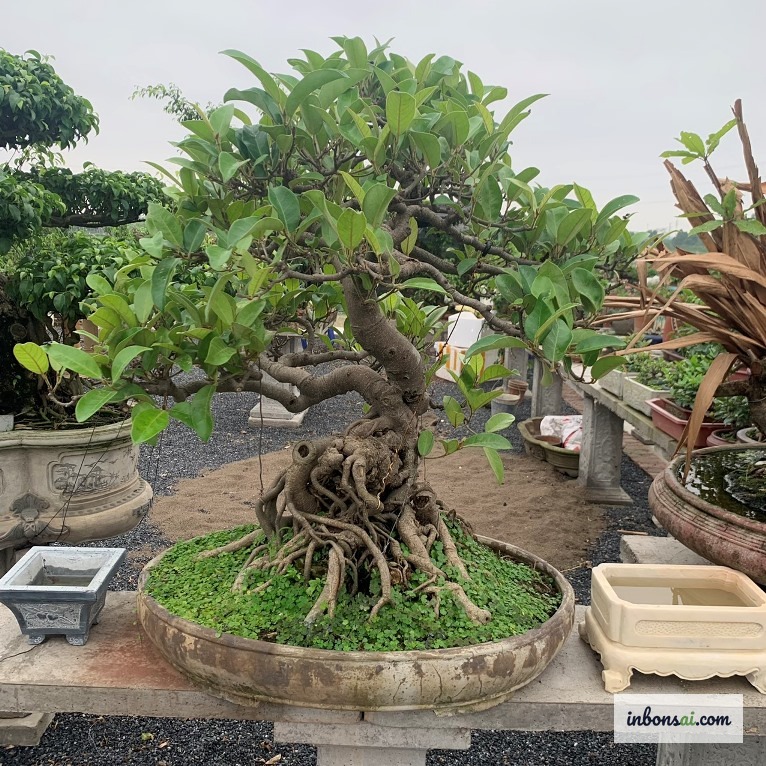
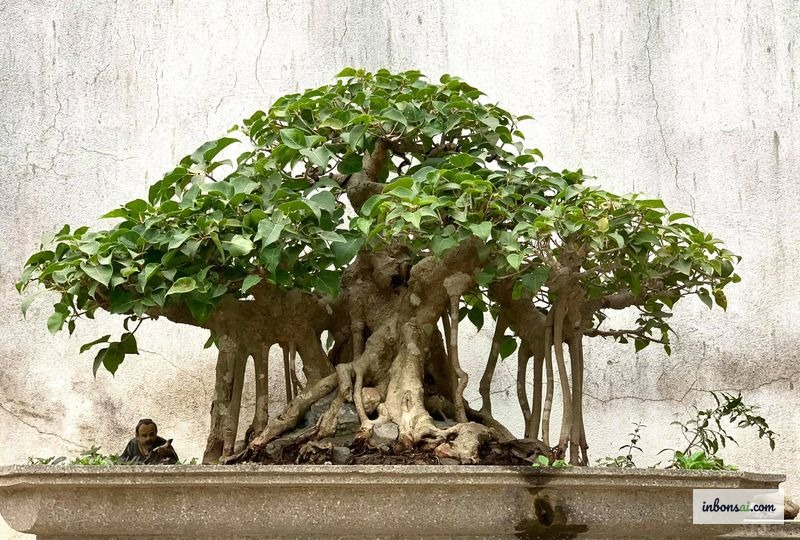
Ficus Religiosa Bonsai: Spiritual Meaning and Care Guide

InBonsai Team
March 29, 2026 · 11 min read
In the world of bonsai, few species carry as much spiritual weight as the Ficus religiosa bonsai — the sacred Bodhi Tree of Buddhism. This is the very tree under which Prince Siddhartha Gautama attained enlightenment, earning it the name “The Tree of Awakening.” As a bonsai, Ficus religiosa brings together the ancient art of miniature tree cultivation and centuries of Buddhist spiritual tradition. This guide will walk you through everything you need to know about the Ficus religiosa bonsai’s spiritual significance, how to select the right pot and soil, and how to care for it at home.
What Is Ficus Religiosa Bonsai? How to Identify It
Ficus religiosa, commonly known as the Sacred Fig, Bodhi Tree, or Peepal tree, belongs to the Moraceae (mulberry) family — the same family as the Ficus benjamina, Ficus microcarpa, and banyan tree. Native to the Indian subcontinent and Southeast Asia, this tropical species has been cultivated in temple gardens, monasteries, and sacred spaces across Asia for thousands of years.
The most distinctive feature of Ficus religiosa is its heart-shaped leaf with an elongated drip tip — unique among ficus species. The deep green leaves are glossy with lightly wavy margins, and their long, slender tips quiver in the slightest breeze — a characteristic movement often called “the trembling of Bodhi leaves.” The bark is pale grey and becomes textured and fissured with age. Like other ficus trees, the Bodhi tree develops aerial roots over time.
Ficus religiosa bonsai is created by training and miniaturizing a mature sacred fig into a bonsai form, typically 20–60 cm tall. Bonsai artists particularly value this species for its vigorous sap production (which speeds healing of pruning cuts), its ability to withstand heavy pruning, and its dense, layered canopy that takes well to styling. It can be grown indoors or outdoors and adapts well to tropical climates.
The Spiritual Meaning of the Bodhi Tree in Buddhism
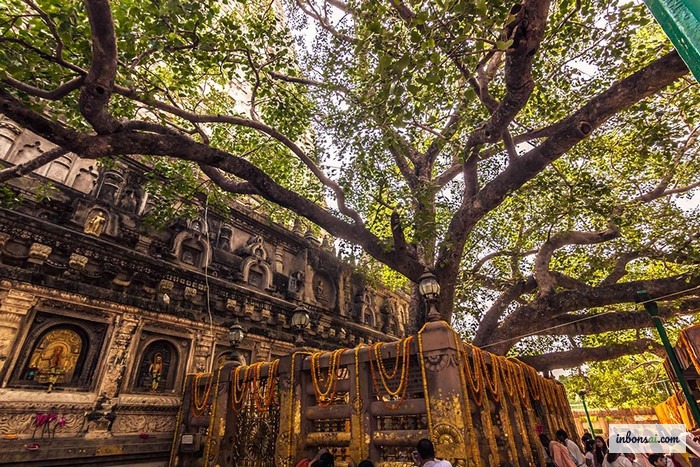
No tree holds deeper spiritual significance in Buddhism than the Bodhi Tree. According to Buddhist scripture, it was beneath a Ficus religiosa at Bodh Gaya in India that Prince Siddhartha Gautama sat in meditation for 49 days and nights, ultimately attaining complete enlightenment and becoming Shakyamuni Buddha. From that moment, the Bodhi tree became known as the “Tree of Enlightenment” — the supreme symbol of liberation, wisdom, and compassion.
In Buddhist cultures across Asia, the Bodhi tree is inseparable from sacred spaces. Most significant Buddhist temples in Vietnam, Thailand, Sri Lanka, and India have at least one Bodhi tree growing in their grounds — both as an ornamental tree and as a spiritual symbol reminding practitioners of the path to awakening.
The specific spiritual meanings of the Bodhi tree bonsai:
- Enlightenment and wisdom: The tree symbolizes the breakthrough from ignorance to clear wisdom. Placing a Bodhi bonsai in a meditation or study space serves as a constant reminder of the journey toward understanding.
- Peace and compassion: Buddhist practitioners believe the Bodhi tree’s spiritual energy fosters inner peace, reduces stress, and cultivates compassion within the home.
- Purification: The tree’s sacred energy is said to cleanse living spaces of negative influences and invite clarity and calm.
- Connection to ancestors: Many Buddhist families place Bodhi bonsai near altars or prayer spaces as a way to honor ancestors and maintain a living connection to the Dharma.
Beyond its role in Buddhism, the heart-shaped Bodhi leaf is one of the most recognizable motifs in Asian art and architecture — appearing in temple carvings, ceremonial objects, and decorative arts — a testament to the tree’s enduring spiritual influence across cultures and generations.
Feng Shui Significance of Ficus Religiosa Bonsai
Beyond its Buddhist spiritual significance, the Ficus religiosa bonsai is highly valued in feng shui. The tree belongs to the Wood element, carrying the energy of growth, vitality, and harmony — suitable for many living and working spaces.
Feng shui by element:
- Water element people: The ideal match — Water feeds Wood, so Bodhi bonsai amplifies and supports those with a Water birth element.
- Wood element people: The bonsai strengthens the dominant element, bringing added vitality and clarity.
- Fire element people: Wood feeds Fire, so a Bodhi bonsai can boost energy for Fire types, though avoid overcrowding with too many plants.
- Metal and Earth element people: More caution is needed — consult a bonsai feng shui compatibility guide before selecting.
Best placement positions:
- Prayer rooms and meditation spaces: The ideal location — spiritual and feng shui energy both work at maximum capacity.
- East or southeast corner: In Bagua theory, the east sector belongs to Wood — placing a Bodhi bonsai here strengthens health and family vitality.
- Desk or workspace: A small Bodhi bonsai on your desk promotes focused thinking and creative insight — especially suited to writers, researchers, and managers.
- Avoid bedrooms: Large plants compete for oxygen at night; if you want Bodhi bonsai in a bedroom, keep it very small (under 20 cm).
One important note: the Bodhi bonsai must be kept healthy and thriving. In feng shui belief, a wilted or dying plant in a sacred space produces negative energy — the opposite of the intended effect. Study care requirements carefully before placing the tree in a prayer area.
Choosing the Right Soil and Pot for Bodhi Bonsai
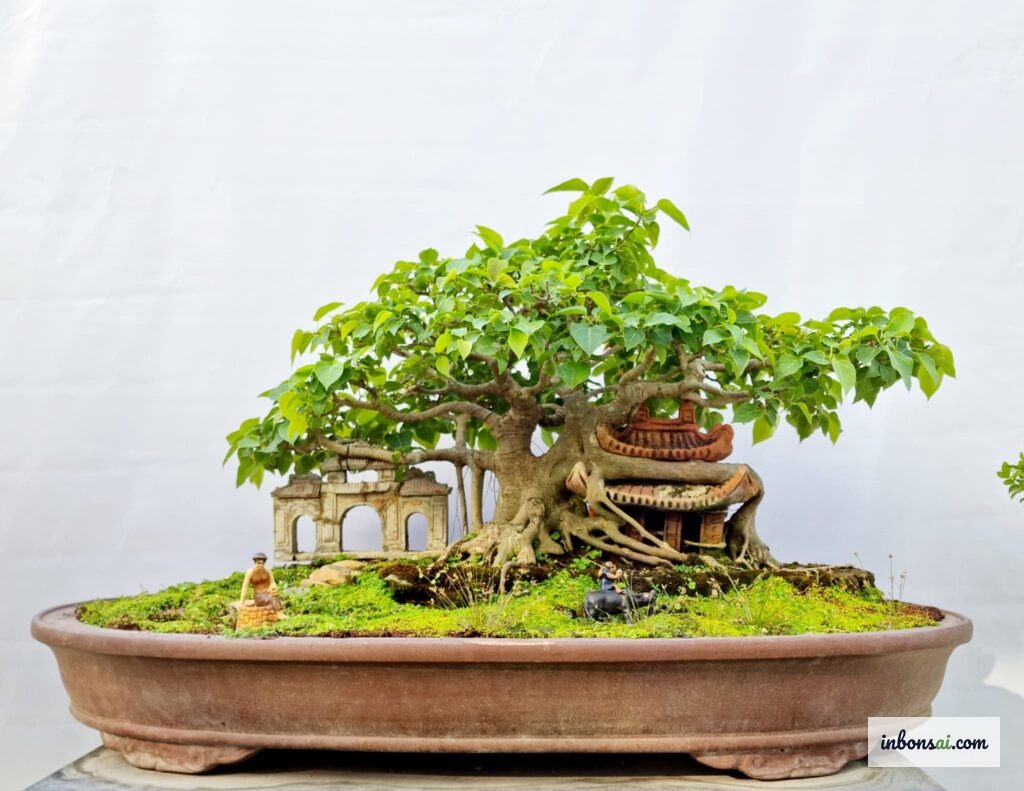
Choosing the right container and growing medium is the foundational step for a healthy, beautiful Bodhi bonsai. Ficus religiosa prefers well-draining conditions — roots rot easily in waterlogged soil — so both pot and growing mix must ensure good drainage.
Choosing the right pot:
A drainage hole at the bottom of the pot is mandatory. For material, unglazed terracotta or Japanese ceramic pots are the best choice: they are breathable, absorb excess moisture, and suit the traditional bonsai aesthetic perfectly. Plastic pots are functional but retain moisture longer.
For size, the pot length should be about two-thirds the height of the tree, and depth should roughly equal the diameter of the trunk base. An oversized pot keeps soil wet too long; a pot that’s too small restricts root development.
For color and style: earthy browns, muted blues, or deep black complement the sacred quality of a Bodhi bonsai. Rectangular or oval pots suit upright (chokkan) styles; round or bowl-shaped pots work well with informal or windswept styles.
Soil mix:
Bodhi bonsai needs a medium that retains some moisture while draining freely. A mix commonly used by Vietnamese bonsai artists:
- 50% Akadama (Japanese fired clay): breathable, moisture-retentive, and mineral-rich
- 30% Pumice (volcanic rock): fast-draining, prevents waterlogging
- 20% Garden soil or loam: provides baseline nutrients
If Akadama is unavailable, use fired clay or small gravel as a substitute. Never use pure garden soil — it compacts when wet and suffocates roots. For a detailed explanation of bonsai soil ratios, see our guide on Akadama pumice perlite bonsai soil mixing ratios.
How to Care for Ficus Religiosa Bonsai at Home
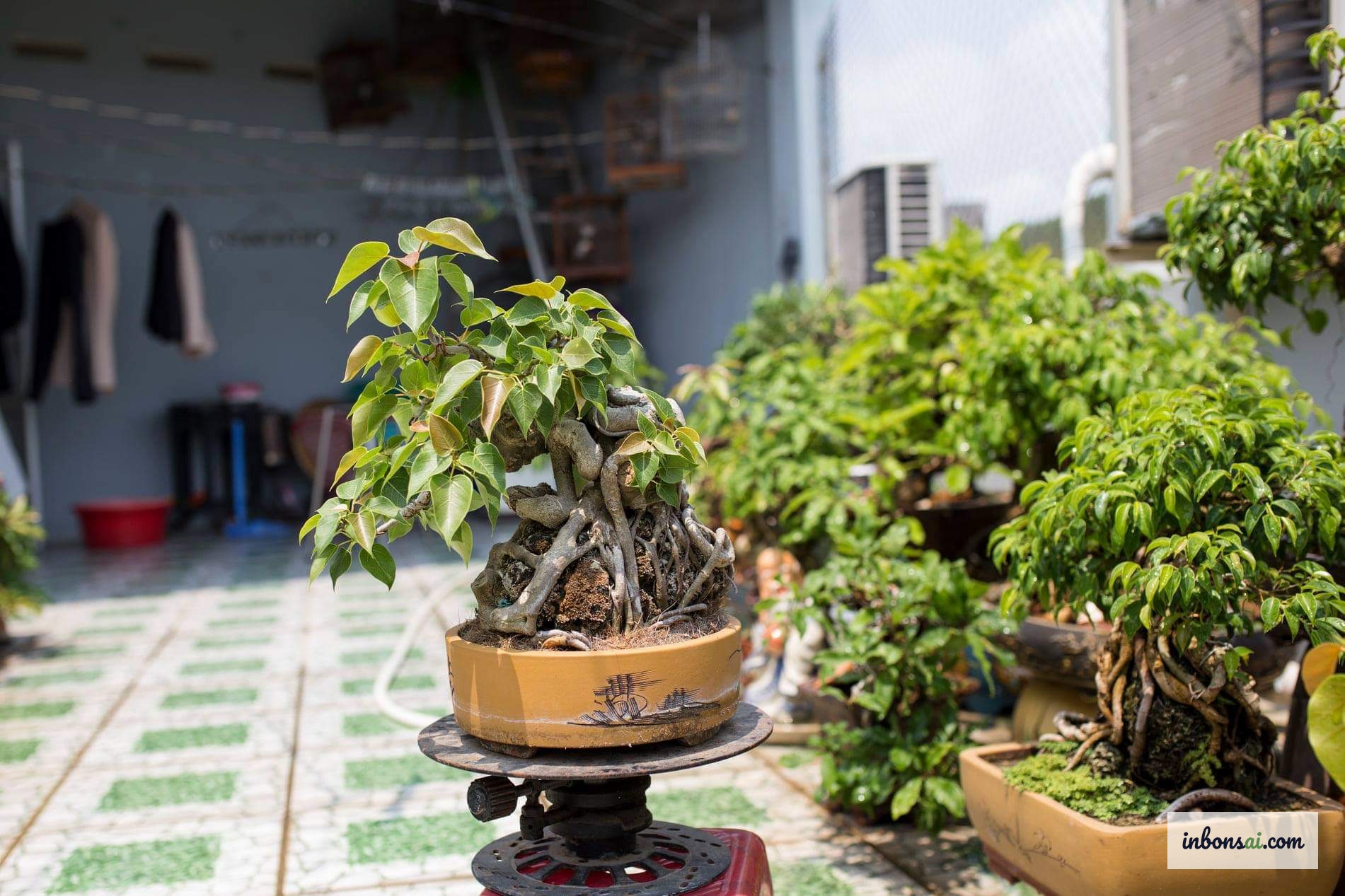
Ficus religiosa bonsai is relatively easy to care for compared to many other bonsai species — it is vigorous, forgiving, and adapts reasonably well to indoor conditions. That said, understanding its needs will keep the tree beautiful and on-track.
Light:
Bodhi bonsai needs at least 4–6 hours of indirect sunlight per day. It prefers moderate light — avoid harsh afternoon sun through glass, which can scorch leaves. Indoors, the best positions are near east-facing windows (gentle morning light) or north-facing windows (diffused light). Insufficient light causes yellowing and leaf drop — move the tree to a brighter spot if this occurs.
Watering:
Water when the top 1–2 cm of soil is dry — typically every 2–3 days in summer, every 4–5 days in winter. Water thoroughly until it flows freely from the drainage hole, then empty any water that pools in the saucer to prevent root rot. Tap water left overnight (to off-gas chlorine) works well; rainwater is ideal. If your bonsai shows signs of wilting or overwatering, consult our guide to rescuing a wilted or waterlogged bonsai.
Fertilizing:
During the growing season (March to September), apply a balanced NPK 10-10-10 fertilizer or slow-release organic pellets every 3–4 weeks. From October through February, reduce or stop fertilizing to allow the tree to rest. Never fertilize a sick tree or one that was recently repotted.
Temperature and humidity:
Bodhi bonsai thrives at 18–32°C — ideal for Vietnam’s tropical climate. It tolerates temperatures down to around 10°C but should not be exposed to sustained cold below that. Aim for 50–70% relative humidity; during dry seasons or when air conditioning runs heavily, mist leaves lightly in the morning to boost ambient humidity around the tree.
Styling and Wiring Your Ficus Religiosa Bonsai
One of the pleasures of Ficus religiosa bonsai is the variety of styles it accepts. Because the tree grows quickly and tolerates pruning well, it can be shaped into many different bonsai forms.
Common styles:
- Formal upright (chokkan): Straight trunk, conical or round canopy — simple, dignified, ideal for prayer or altar spaces.
- Informal upright (moyogi): Gently curving trunk, natural silhouette — the most common style, suitable for any setting.
- Semi-cascade (han-kengai): Trunk and branches draping gracefully past the rim of the pot — evokes an old tree growing on a cliff face.
- Multi-trunk (kabudachi): Multiple trunks from a single base — Ficus religiosa is well-suited to this style since it readily produces basal shoots.
Pruning technique:
Prune every 2–3 months during the growing season. Use sharp bonsai scissors and cut just above a leaf node to encourage new growth. Note that Ficus religiosa exudes white latex sap when cut — this is completely normal; simply allow it to dry naturally without applying anything to the wound. For pruning fundamentals, see our basic bonsai branch pruning guide.
Wiring:
Use aluminum or copper wire with a diameter about one-third the thickness of the branch being shaped. Wrap the wire at a 45° angle around the branch, then gently bend it into position. Remove after 3–6 months to prevent the wire from cutting into the bark. Since Ficus religiosa grows rapidly, check wires more frequently than you would with slower-growing species.
Important Considerations When Growing Bodhi Bonsai
Despite being relatively easy to care for, there are several important points to keep in mind to avoid common mistakes:
Sap can cause skin irritation: The white latex sap of Ficus religiosa (common to all fig-family plants) can irritate the skin and eyes of sensitive individuals. Wear gloves when pruning, and avoid contact with eyes. If you have young children or pets at home, be aware that ingesting Bodhi leaves can cause digestive discomfort.
Avoid sudden location changes: The Bodhi bonsai is sensitive to environmental shifts — moving the tree abruptly from indoors to outdoors (or vice versa) can trigger mass leaf drop. Transition gradually over 1–2 weeks.
Monitor for pests: Spider mites and mealybugs are the two most common pests on Ficus religiosa bonsai. Check the undersides of leaves weekly; if found, treat promptly by wiping leaves with a damp cloth or spraying diluted neem oil.
Repot on schedule: Repot every 2–3 years in early spring (February–March). Ficus religiosa develops roots quickly — when roots begin emerging from the drainage hole or the tree dries out unusually fast after watering, it’s time to repot. See our guide to repotting bonsai properly to avoid common mistakes.
Respect the spiritual dimension: If you are growing a Bodhi bonsai for spiritual or religious purposes, care for it with reverence — a healthy, thriving tree is what brings positive energy. A neglected or dying tree in a sacred space is believed to produce the opposite effect. For a solid foundation before caring for this special species, read our beginner’s guide to bonsai.
Related Posts
Ficus Religiosa Bonsai: Spiritual Meaning and Care Guide
Starfruit Bonsai Mini: Feng Shui Meaning and Care Guide
Ficus Racemosa Bonsai: Feng Shui Meaning & Care Guide
Loc Vung Bonsai: Feng Shui Meaning and Shaping Guide
Bougainvillea Bonsai Mini: Feng Shui Meaning & Care Guide
Ficus Bonsai Mini: Feng Shui Meaning and Care Guide
Pomegranate Bonsai Yellow Leaves: Causes & Treatment Guide