Starfruit Bonsai Mini: Feng Shui Meaning and Care Guide

InBonsai Team
April 12, 2026 · 12 min read
If you are looking for a bonsai that is beautiful, produces real fruit, and carries deep feng shui meaning — starfruit bonsai mini is the perfect answer. The starfruit (Averrhoa carambola) has been cherished in Vietnamese and Asian cultures for generations: its five-pointed star shape when sliced symbolizes the five blessings (wealth, status, longevity, health, and peace), while the vivid golden color of ripe fruits evokes images of gold and prosperity. This guide will walk you through the feng shui significance of starfruit bonsai, how to select a quality tree, and all the techniques to grow and care for one successfully at home.
What Is Starfruit Bonsai Mini? Key Characteristics
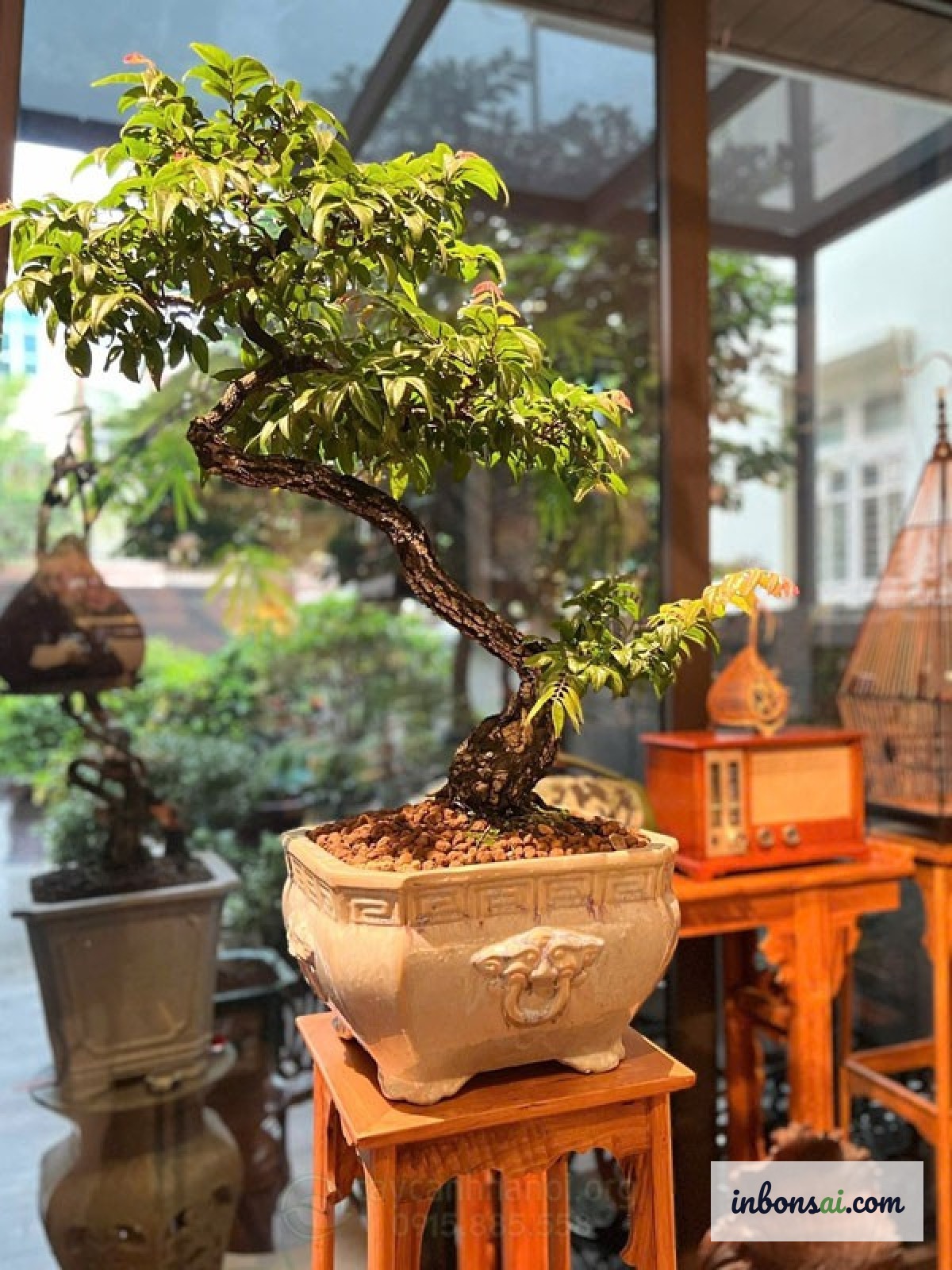
Starfruit, scientific name Averrhoa carambola, belongs to the family Oxalidaceae and is a tropical fruit tree native to South and Southeast Asia. In nature, starfruit trees grow 5–12 meters tall. When cultivated as bonsai, skilled artists reduce them to just 20–60 cm while preserving their ability to flower and bear fruit.
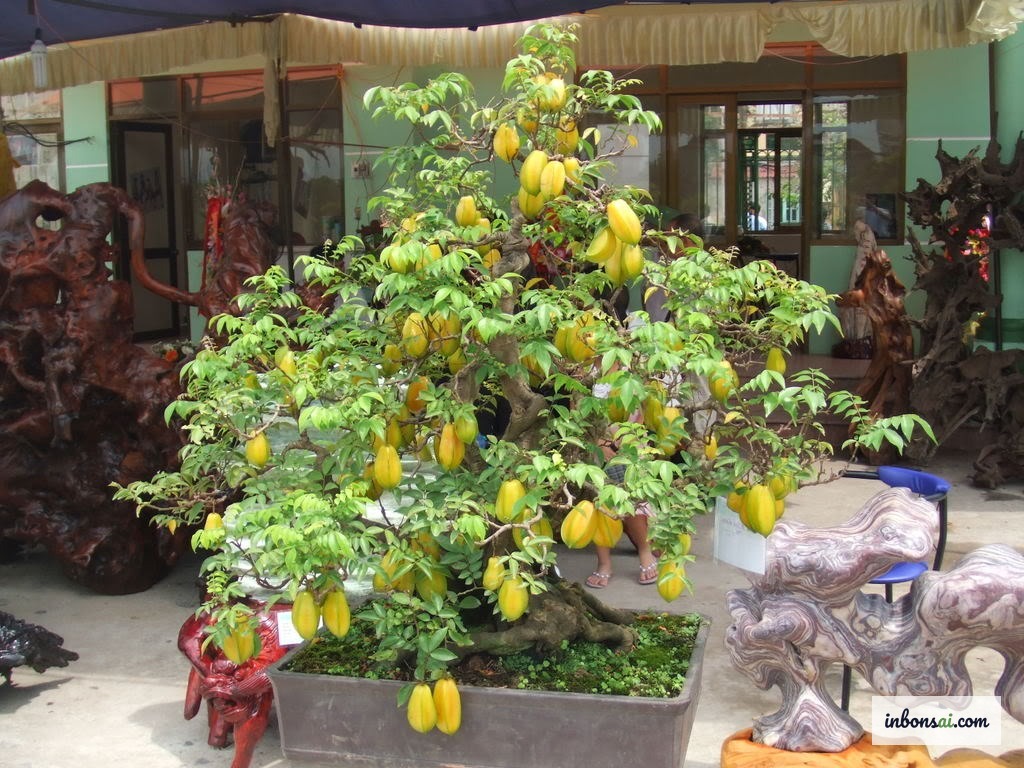
What makes starfruit bonsai truly special is its ability to produce fruit even at miniature size. Clusters of five-ribbed, star-shaped fruits in shiny yellow-green tones hanging from a tree barely half a meter tall create an image that is both magical and captivating. This is why starfruit bonsai mini is increasingly popular as a decorative piece for desks, bookshelves, and living room spaces.
Identifying features of starfruit bonsai mini:
- Pinnately compound leaves with oval leaflets arranged symmetrically along the midrib — they fold automatically at night
- Small pink-purple flowers growing in clusters directly from the trunk and older branches (cauliflory)
- Distinctive five-ribbed star-shaped fruits, 5–12 cm long, yellow-green to orange-yellow when ripe
- Rough, gray-brown bark with natural branching that forms a beautiful canopy with minimal intervention
Beyond aesthetics, starfruit also has a continuous flowering and fruiting cycle — a healthy tree can bloom 3–4 times per year, ensuring your bonsai always has something interesting to admire through every season.
Feng Shui Meaning of Starfruit Bonsai Mini
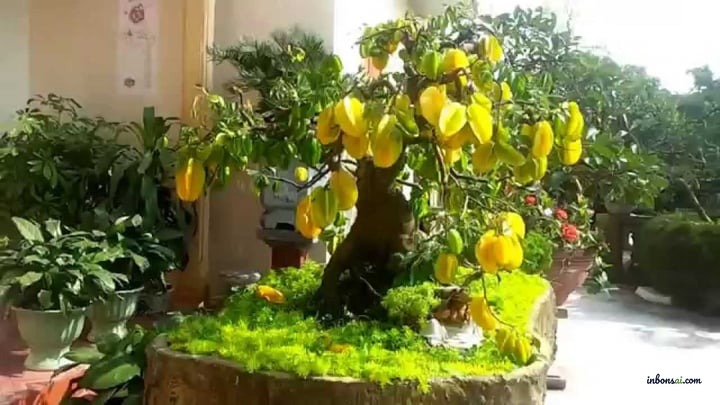
In Vietnamese folk culture and many Asian traditions, starfruit bonsai mini carries a rich and highly positive system of feng shui meanings.
The Five Blessings (Ngũ Phúc): A starfruit has exactly five ribs when cut crosswise, and Vietnamese people have long associated this image with the “five great blessings”: wealth (phú), status (quý), longevity (thọ), health (khang), and peace (ninh). Placing a fruiting starfruit tree in your home is a traditional way to invite all five blessings at once.
Wealth and Gold: The golden color of ripe starfruits evokes gold bullion and prosperity. In feng shui theory, yellow belongs to the Earth element — representing stability, accumulation, and abundance. This is why many business owners place starfruit bonsai in their offices or storefronts to attract financial luck.
Wood Element — Compatible with Many Birth Years: Starfruit belongs to the Wood element, making it most suitable for people with Water destiny (Water nourishes Wood) and Wood destiny (strengthens the ruling element). Those with Fire destiny also benefit (Wood feeds Fire). To find which bonsai best matches your birth year, see the guide to choosing feng shui bonsai by birth year.
Uninterrupted Prosperity: Unlike many bonsai species that fruit only once a year, starfruit flowers and fruits year-round — symbolizing an uninterrupted flow of abundance and wealth that is not limited by season.
Best placement: The southeast corner (wealth sector) or east area (health and vitality sector) of the living room or office. Avoid placing in bedrooms (the tree’s energy is too active for a rest space) or kitchens (temperature fluctuations stress the tree).
How to Choose a Quality Starfruit Bonsai Mini
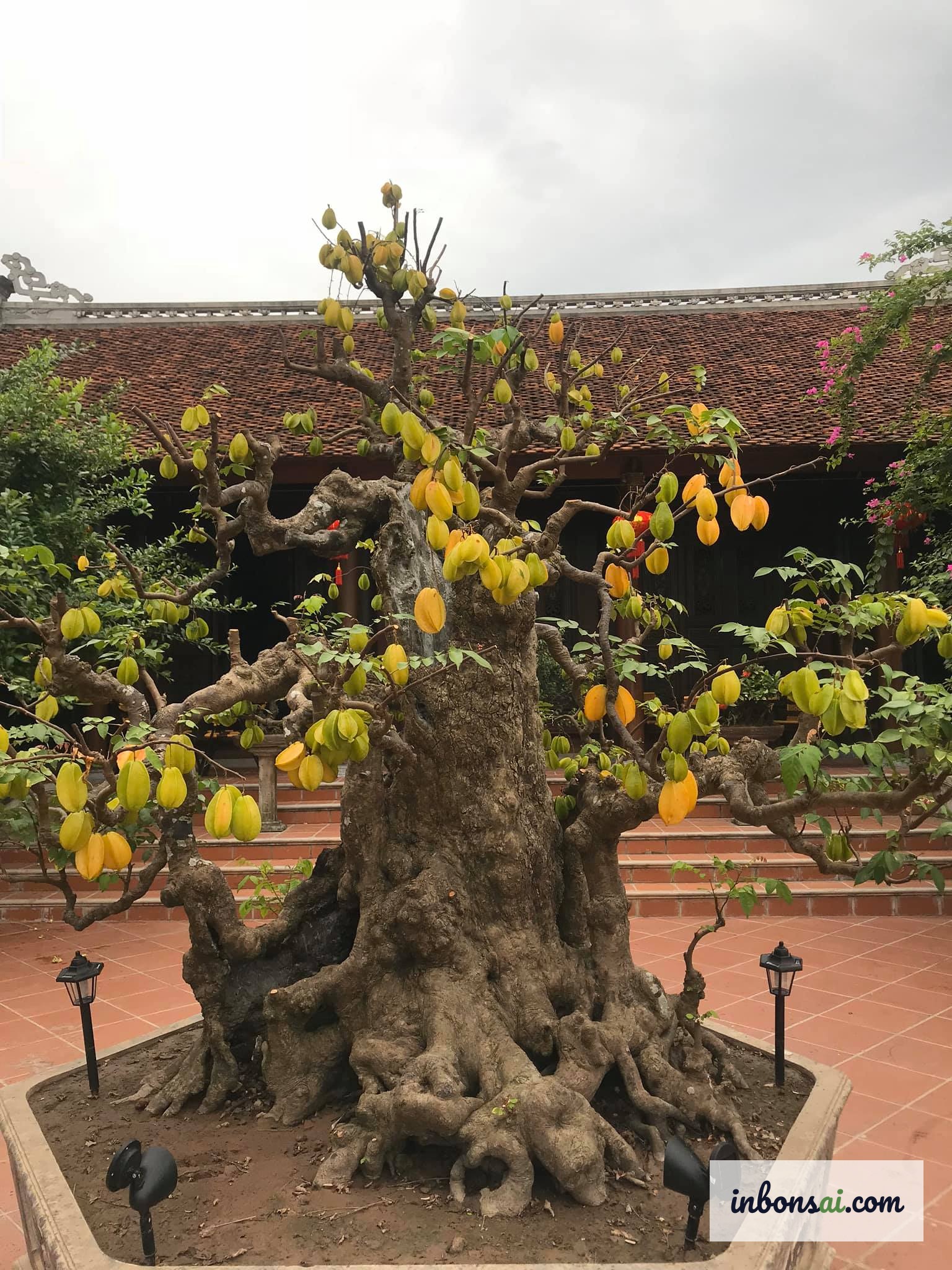
The bonsai market today is varied, with quality ranging widely. When selecting a starfruit bonsai mini, pay attention to these criteria to avoid purchasing a sick tree or one incapable of bearing fruit.
Prioritize trees currently bearing fruit or flowers: This is the single most important criterion. A tree bearing fruit proves it has reached sufficient maturity and is in a healthy growing state. A tree that is lush and green but has never fruited may be too young or improperly cultivated to produce fruit.
Evaluate the trunk and base: A beautiful trunk has a natural taper from base to tip, with gray-brown bark showing natural small cracks — signs of an aged tree. The base should flare slightly and emerge above the soil surface (nebari), creating a sense of stability and deep-rootedness. Avoid trees with completely smooth trunks — these are very young and will need years more before developing bonsai-worthy aesthetics.
Check leaves and canopy: Quality starfruit bonsai leaves are small, glossy, and evenly distributed along branches. The canopy should be balanced and well-layered. If leaves show yellowing patches, brown spots, or curling — these are signs of pests, disease, or nutritional deficiency. Avoid these trees.
Ask about history and care: How long has the tree been in the pot? What fertilizer is used? Is it regularly placed outdoors in sunlight? This information helps you gauge the acclimatization period after bringing the tree home.
Pricing: Starfruit bonsai mini typically ranges from 300,000 – 3,000,000 VND depending on size, age, and quality. For desktop decoration and feng shui purposes, trees in the 500,000 – 1,500,000 VND range are an excellent choice for beginners.
Planting Starfruit Bonsai Mini: Soil, Pot, and Position
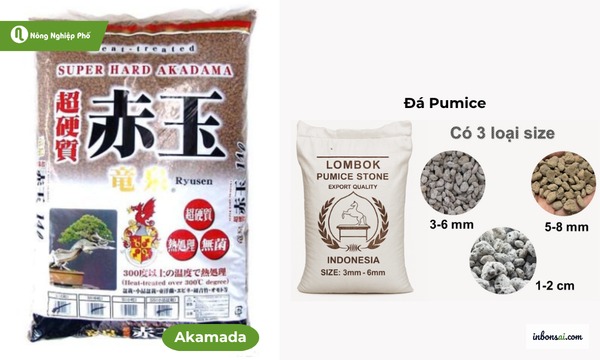
The foundation of a healthy starfruit bonsai begins with choosing the right pot, soil, and placement from the start.
Choosing the right pot: Unglazed ceramic or terracotta pots are the best choice for starfruit bonsai — these materials allow air exchange, preventing roots from suffocating and providing good moisture drainage. The pot size should be approximately 2/3 of the canopy width — large enough for root development but not so large that the soil stays perpetually wet (which leads to root rot). A drainage hole at the bottom is an absolute must. Aesthetically, pots in red-brown or celadon green tones beautifully complement the yellow fruits.
Ideal soil mix: Starfruit prefers well-aerated, fast-draining soil that still retains enough moisture and nutrition to support fruit development. Recommended mix: 40% akadama (or fired clay granules), 30% pumice (volcanic pumice stone), 30% loam or organic compost. If akadama is unavailable, commercially prepared bonsai soil from a garden center is an acceptable substitute. Never use pure garden soil — it compacts tightly and holds too much moisture in small containers, quickly causing root rot.
Planting and repotting: Before planting, soak a new ceramic pot in water for at least 30 minutes so the pot absorbs moisture and does not pull water from the soil immediately after planting. Cover the drainage hole with fine mesh. Add a base layer of soil, place the tree, adjust the angle and canopy orientation for a pleasing view from multiple sides, then fill in soil and gently firm it down with a wooden chopstick to eliminate air pockets. Water thoroughly and keep the tree in cool indirect light for the first 2 weeks.
Ideal placement: This is a point many new bonsai enthusiasts overlook — starfruit bonsai is NOT shade-tolerant. The tree needs at least 4–6 hours of natural sunlight each day to flower and fruit consistently. A position near an east- or south-facing window is ideal. If your indoor space lacks adequate light, bring the tree out to a balcony in the morning regularly. Avoid direct air-conditioning airflow and strong drafts.
Caring for Starfruit Bonsai Mini at Home
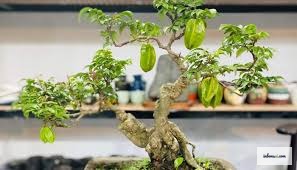
Caring for starfruit bonsai mini is not overly complex if you understand the tree’s needs. Here are the key points.
Watering: The golden rule is water when the soil surface begins to dry — not on a fixed schedule. Press your finger 2–3 cm into the soil: if it feels dry, water thoroughly; if still moist, wait. When watering, soak until water flows freely from the drainage hole, then empty the saucer. In hot summer, watering every 1–2 days may be necessary; in winter, every 3–5 days. Starfruit appreciates high ambient humidity — misting the leaves in the early morning helps, especially in air-conditioned rooms.
Light and temperature: Starfruit is a tropical tree that loves warmth and brightness. Ideal temperature range: 20–35°C. The tree tolerates temperatures down to about 10°C, but below this threshold it experiences cold shock, drops leaves, and stops flowering. If you live in northern Vietnam, bring the tree indoors when night temperatures fall below 15°C.
Fertilizing: During the growing season (March through October), fertilize every 2–3 weeks. Use balanced NPK fertilizer or bonsai-specific feed during the leaf and branch growth phase. When the tree begins forming flower buds, switch to phosphorus-potassium-rich (P-K high) fertilizer to support flowering and fruit development. Slow-release organic fertilizer pellets placed on the soil surface are a safe and long-lasting choice for bonsai. Do not fertilize while the tree is bearing ripe fruit or immediately after repotting.
Repotting: Starfruit mini needs repotting every 2–3 years when roots fill the pot. The best time is early spring, before the first flowering period of the year. During repotting, trim 1/4 to 1/3 of the root mass and completely replace the soil. After repotting, keep the tree in cool shade for 2–3 weeks before returning it to full sunlight.
For broader bonsai care principles applicable to many desktop species, see the complete guide to mini bonsai care at home.
Shaping Starfruit Bonsai Mini
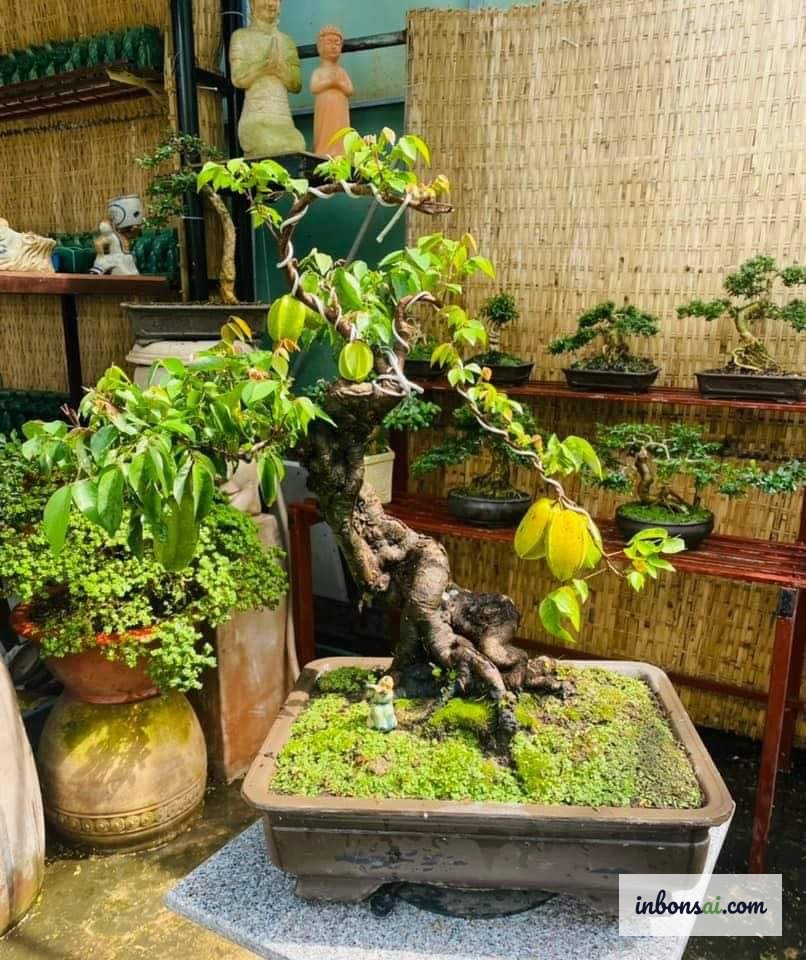
Shaping transforms a potted starfruit into a true bonsai artwork. Starfruit has flexible branches when young that harden quickly with age — so starting shaping early makes the process much easier.
Pruning (structural trimming): This is the most important step and should be performed regularly. Use sharp, clean bonsai scissors to remove vertically growing branches, crossing branches, downward-facing branches, or any branch that is too long and disrupts overall balance. Cut just above a leaf node — the tree will sprout 1–2 new branches at the cut point, helping the canopy thicken and branch more densely. The best time for heavy pruning is after the fruit harvest or in early spring before the tree flowers.
Wiring: Wrap soft aluminum wire at a 45-degree angle around the branch, then gently bend the branch to the desired direction. Do not bend too forcefully or too quickly — branches can snap under pressure. Monitor wired branches after 4–8 weeks: once the branch has memorized its new shape, remove the wire immediately to prevent it from cutting into the bark and leaving unsightly scars. For starfruit mini, natural slanted style (Shakan) or literati style (Bunjin) with a light, open canopy suits the tree’s graceful character beautifully.
Stimulating flowering and fruiting: After heavy pruning, apply P-K-rich fertilizer to encourage flower bud formation. Increase sunlight exposure during this period. A useful trick shared by experienced growers: allow the soil to dry slightly for 2–3 weeks (mild water stress), then water thoroughly — this mild stress triggers a strong flowering response, similar to the technique used to encourage plum blossom (mai vàng) to bloom.
Suitable bonsai styles: Formal upright (Chokkan) — dignified, ideal for feng shui purposes; Slanted (Shakan) — expresses resilience; Clump (Kabudachi) — multiple trunks suggest abundant growth and continuous good fortune.
Common Problems and Solutions
Even though starfruit is relatively easy-going, some problems can arise — especially for beginners. Early identification makes all the difference.
Yellow leaves and heavy leaf drop: Most commonly caused by insufficient light or overwatering. Check by pressing a finger into the soil — if it feels constantly moist, reduce watering frequency and improve soil drainage. If the soil is dry but leaves are still yellowing — move the tree to a brighter spot. Leaf drop right after purchase is usually a normal acclimatization response; the tree will recover within 2–4 weeks.
Tree refuses to flower: Usually due to insufficient light, lack of phosphorus-potassium, or the tree being too young. Solution: move the tree outdoors into gentle morning sun, apply P-K-rich fertilizer, and try mild water stress (water less for 2–3 weeks then water deeply).
Premature fruit drop: Often occurs when the tree experiences sudden environmental changes, lack of water during fruit development, or is placed in direct cold air-conditioning airflow. Solution: keep the tree in a stable position, water more consistently while the tree is bearing fruit, and keep it away from cold drafts.
Pests: Mealybugs create white fluffy clusters at leaf bases and branch axils — treat by daubing 70% isopropyl alcohol directly on the bugs or spraying diluted neem oil. Red spider mites cause silvery, dry leaves — increase ambient humidity and mist leaves regularly as prevention. Inspect the tree every 2 weeks to catch problems early.
For more desktop bonsai options with feng shui meaning, explore the top desk bonsai for attracting prosperity and fig bonsai mini feng shui guide.
Conclusion
Starfruit bonsai mini is a perfect fusion of bonsai artistry and Asian feng shui culture — visually stunning and carrying a meaningful story of five blessings, wealth, and uninterrupted abundance. With the right care — adequate sunlight, thoughtful watering, and balanced fertilization — starfruit bonsai will flower and fruit year-round, transforming your desk or living room into a vibrant, lively space.
Start with a small, affordable starfruit bonsai mini. Learn to observe the tree each day and through each season. And when the very first star-shaped fruit begins to hang from those tiny branches — you will understand why bonsai enthusiasts say this art form brings a joy that nothing else can replace.
Related Posts
Starfruit Bonsai Mini: Feng Shui Meaning and Care Guide
Ficus Racemosa Bonsai: Feng Shui Meaning & Care Guide
Ficus Benjamina Mini Bonsai for Your Desk: Care Guide
Bougainvillea Bonsai Mini: Feng Shui Meaning & Care Guide
Ficus Religiosa Bonsai: Spiritual Meaning and Care Guide
Loc Vung Bonsai: Feng Shui Meaning and Shaping Guide
Ficus Bonsai Mini: Feng Shui Meaning and Care Guide